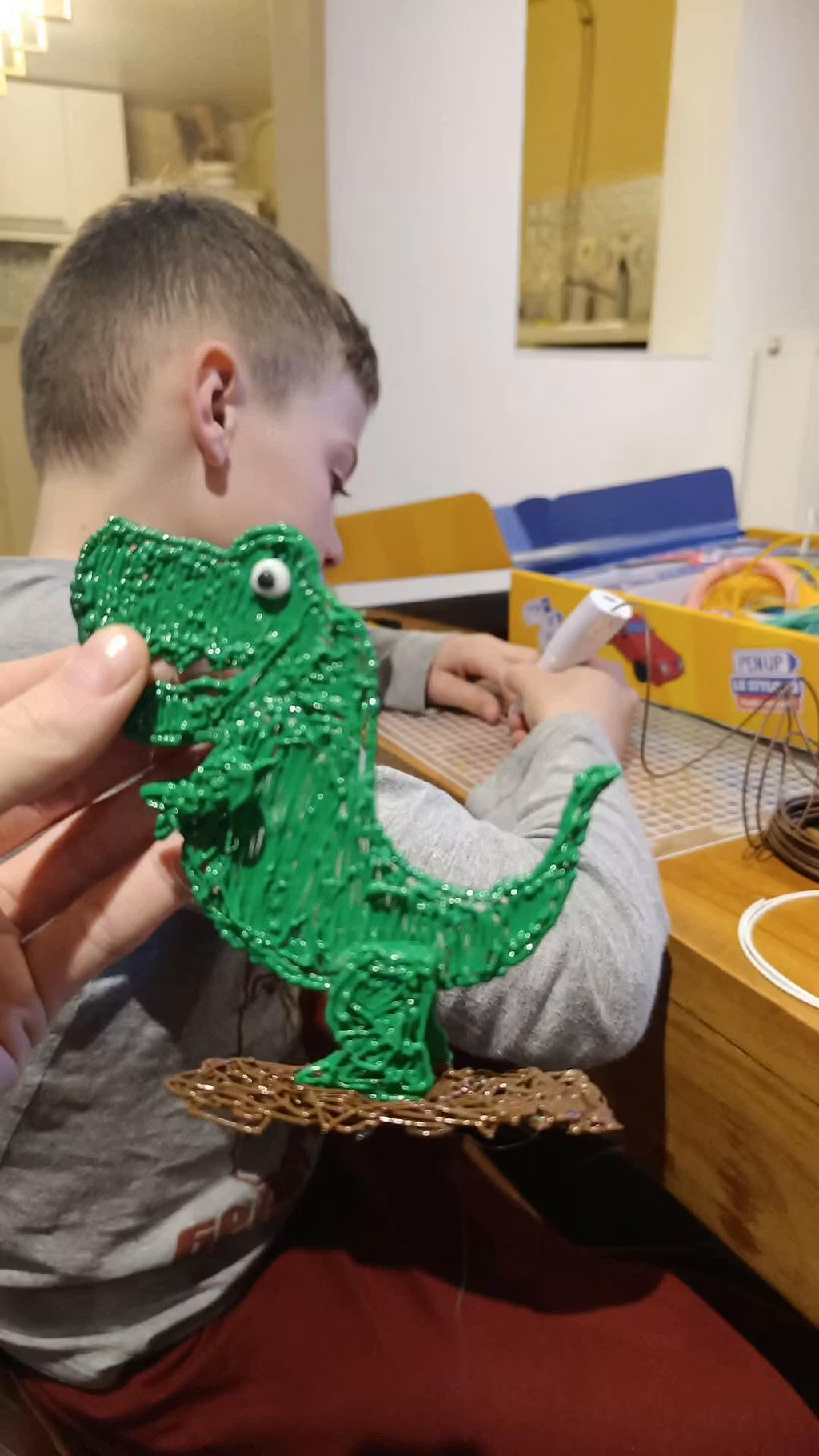


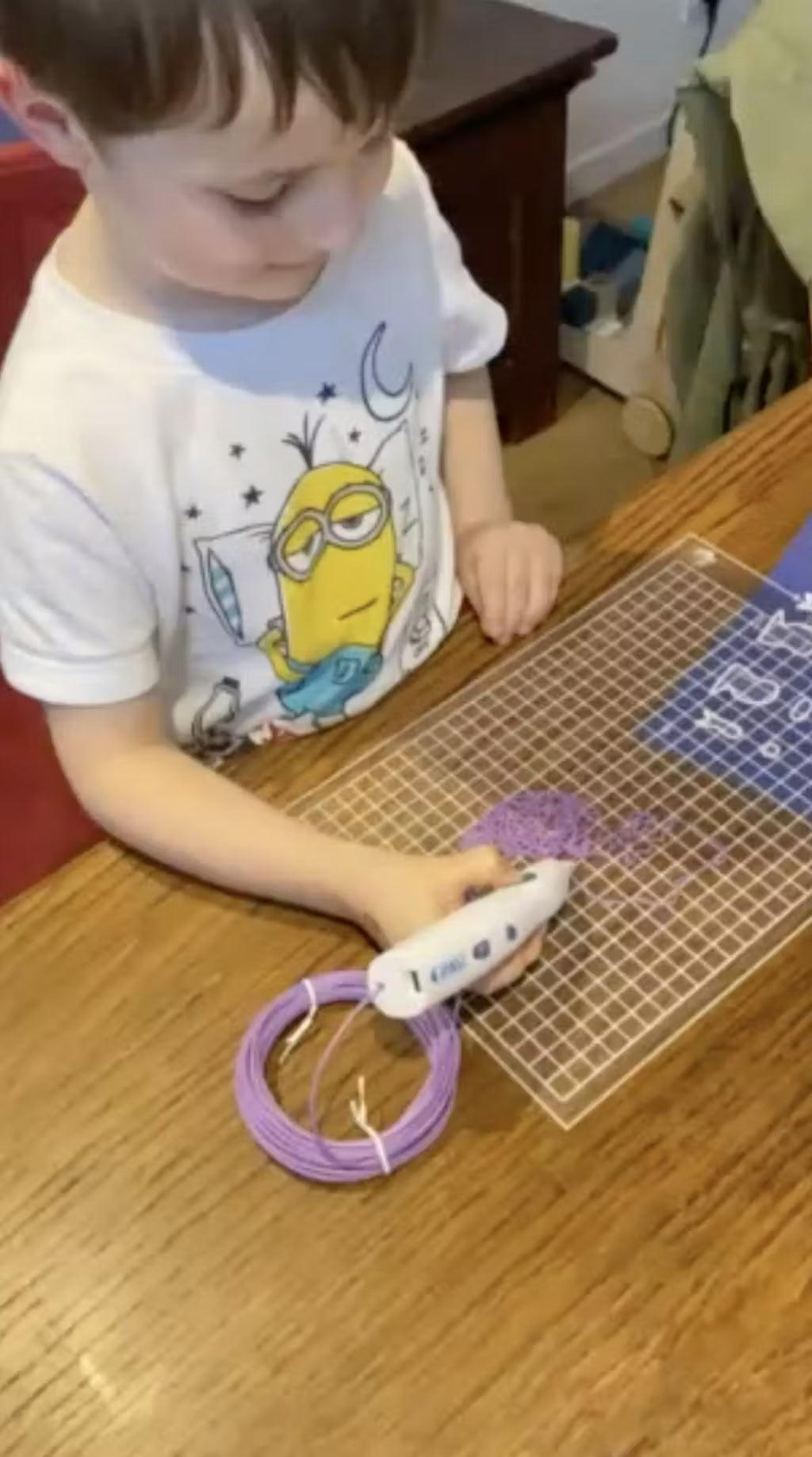
The 3D printing pen sparks curiosity: is it a miniature 3D printer? A toy? A maker's tool? A bit of all of these. In practice, a 3D printing pen melts a plastic filament that hardens within seconds at the tip: you "print" freehand, with no machine, no software, no file. Here's how it works, what it can really do, and how to choose the right model depending on who will be using it.
3D printing pen: how does it work?
The principle is the same as that of a 3D printer, stripped down to the essentials. A spool of plastic filament feeds the pen; a heating element melts the filament to its melting point; a motor pushes it toward the tip; the plastic comes out molten and hardens on contact with air within seconds. Your hand replaces the machine: instead of depositing layers automatically, you draw — flat first, then in volume.
There is therefore no 3D file, no software, no bed leveling: you plug it in (or turn it on, for battery-powered models), insert the filament, and draw. That's what makes the tool accessible from childhood, whereas a 3D printer requires genuine technical learning.
3D pen or 3D printer: they're not used the same way
| Criterion | 3D printing pen | 3D printer |
|---|---|---|
| Ease of use | Immediate, from age 6 depending on the model | Software, files, settings: more for teens and adults |
| What you produce | Freehand creations: figurines, decorations, jewelry | Precise, repeatable parts from a file |
| Gesture | Creative, close to drawing | Technical, close to manufacturing |
| Budget | From €50 to around €100 for a complete pack | From €200 to several thousand euros |
| Size | Fits in a pencil case | A dedicated desk space |
The two tools are complementary rather than competing: many makers actually use a 3D pen to touch up or weld parts that came off a printer. But for a child, the pen is the natural entry point into 3D printing: the gesture is creative, and the result is immediate.
The question that changes everything: temperature
Not all 3D printing pens are equal, and the key difference comes down to one number: the tip temperature.
- PLA/ABS pens, designed for adults and makers, heat up to between 160 and 230 °C. Precise and versatile, but the tip burns on contact.
- Low-temperature pens use a PCL filament that melts at around 60–80 °C. The Pen'Up 3D goes further: 35 °C at the tip surface, verified in the laboratory, which allows a child to use it independently from age 6.
To explore this topic further, our article cold vs. hot 3D pen compares the two families in detail.
What can you create with a 3D printing pen?
The range is wider than you might think: figurines and animals, jewelry and accessories, bedroom or party decorations, raised letters and names, small structures assembled from flat-drawn parts. The simplest method to get started: print a template, slip it under a sheet of paper or a stencil, trace the outline, then assemble the pieces. We provide free printable templates, sorted by difficulty, so you can start on day one.
On the consumable side, the filament is refilled just like felt-tip pens: Fil'Up refills are available individually or in packs, in dozens of colors.
How to choose your 3D printing pen?
Five criteria narrow it down, regardless of where you buy:
- The stated surface temperature, with a specific number. No number, walk away.
- Safety standards: CE and EN71 for use by children.
- Flow: a steady, jam-free output makes all the difference between creating and getting frustrated.
- Refills: a standard consumable, available over the long term.
- After-sales service: an identifiable point of contact, ideally in your language.
For a complete overview of the topic (ages, safety, learning), our complete guide to the 3D pen for children remains the best starting point.
Frequently asked questions
Does a 3D printing pen replace a 3D printer?
No, and that's not what it's designed for. A printer produces precise parts from a file; the pen lets you create freehand, with no prior technique required. To introduce a child to 3D printing, the pen is the ideal first step — and possibly a printer years later.
From what age?
It all depends on the temperature. A standard PLA/ABS pen is not suitable for children. A low-temperature pen with a clearly stated figure, like the Pen'Up 3D at 35 °C on the surface, can be used independently from age 6. Our article 3D pen: from what age? provides full guidance.
What filament does a 3D printing pen use?
The one recommended by the manufacturer: PLA or ABS in 1.75 mm for high-temperature pens, PCL for low-temperature pens. The two are not interchangeable: PCL melts at a much lower temperature, which is precisely what makes it suitable for children.
In summary: the 3D printing pen puts freehand 3D creation within reach, with no machine or software needed. The right model comes down to one real question: who will use it? For a child, insist on a numbered surface temperature, toy safety standards, and easy refills — that's exactly what the Pen'Up 3D is built for.