

Updated on July 19, 2026
The 3D pen for kids has become one of the most requested creative gifts, as well as a major source of questions for parents. What is the right age? Does it burn your fingers? Is it truly useful, or just another gadget abandoned after three days? This complete guide answers everything simply to help you choose the right 3D pen and give your child a genuine, screen-free creative activity.
What is a 3D pen for kids?
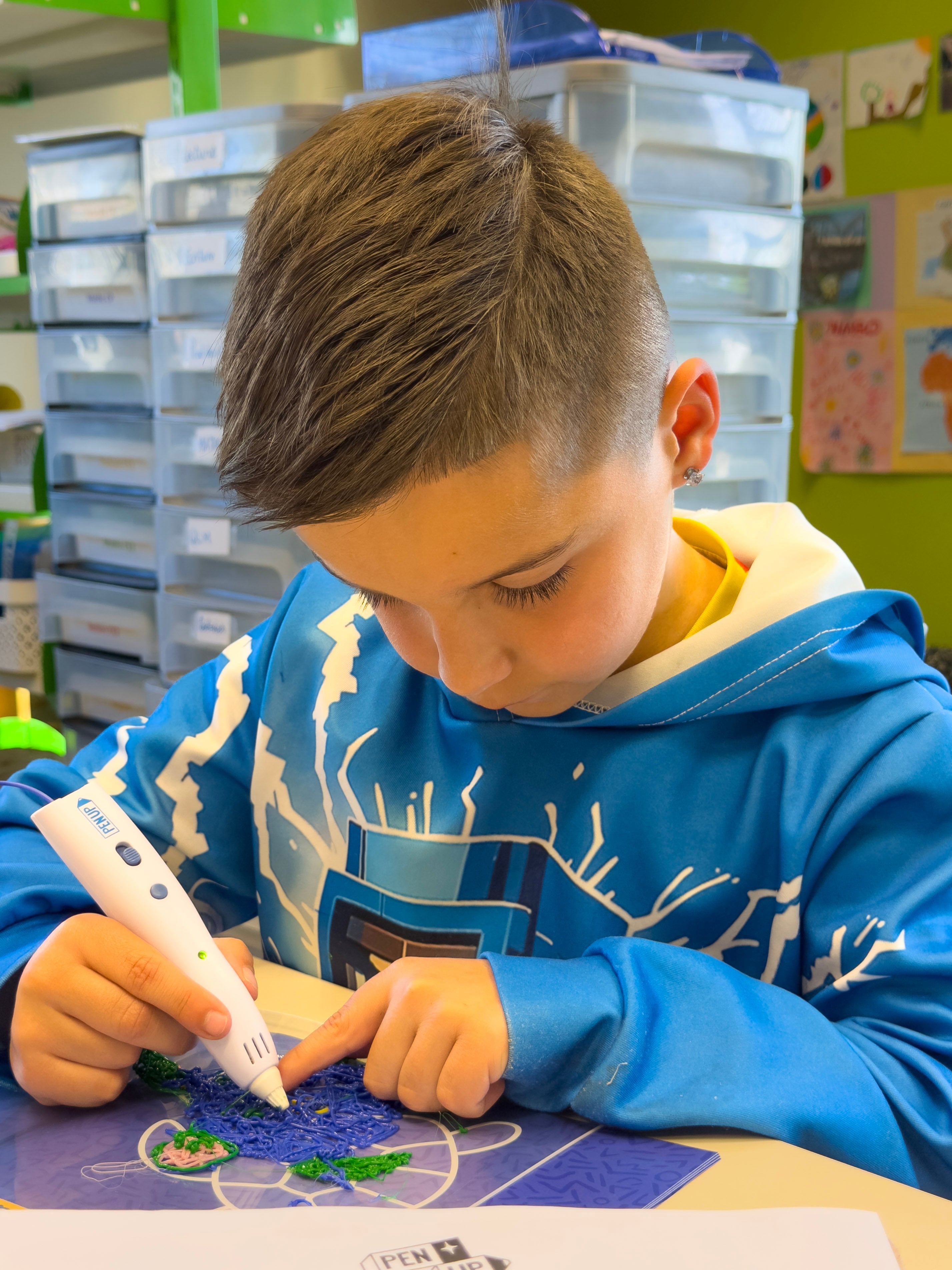
A 3D pen for kids is a pen that melts a flexible plastic filament (PCL melts inside the pen at around 60 °C / 140 °F) and extrudes it through a tip whose surface stays at 35 °C (95 °F): the filament hardens in seconds upon contact with the air, allowing children from age 6 to draw in 3D rather than just on paper.
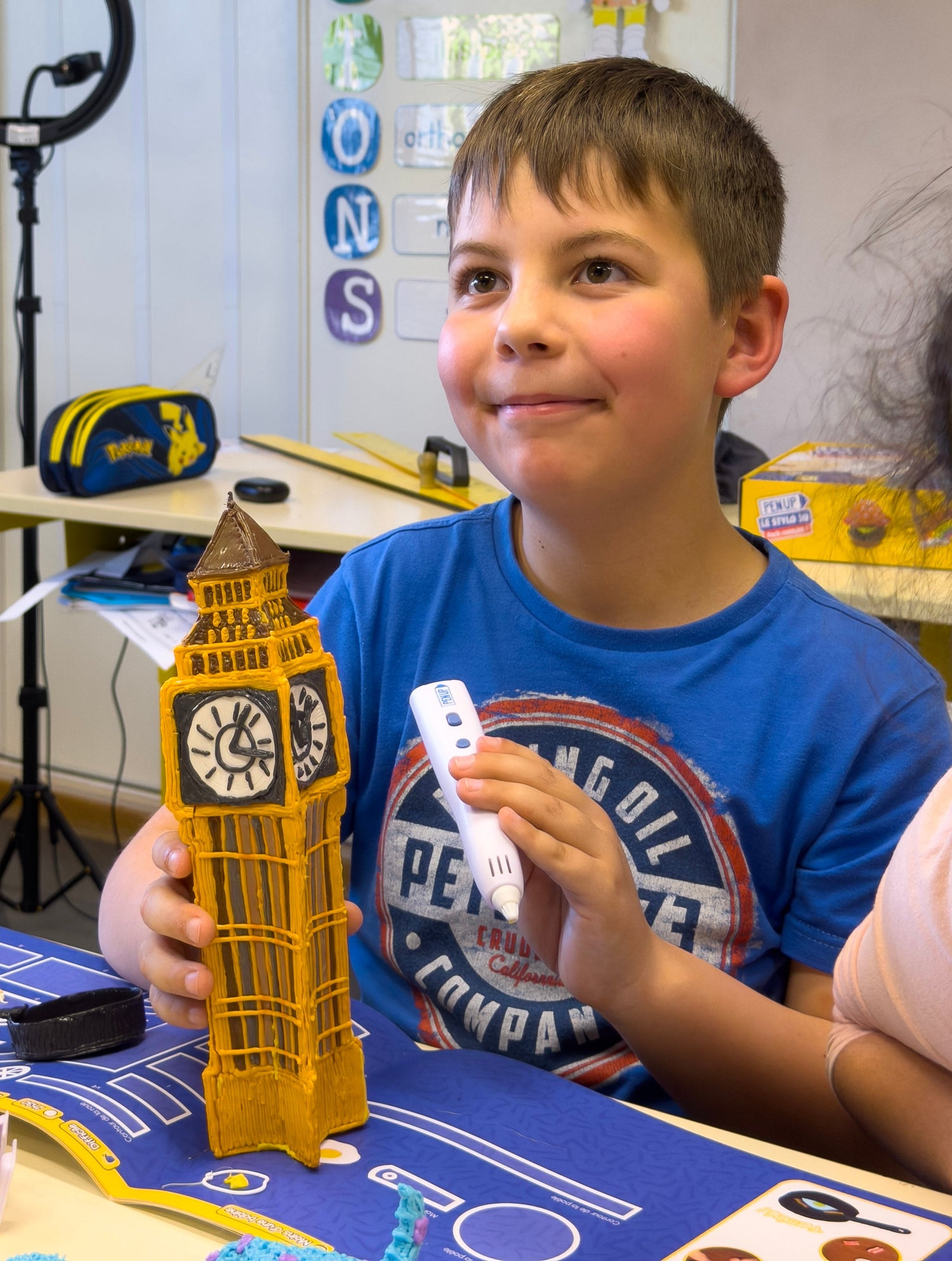
The result: children are no longer just drawing on paper, they are drawing in three dimensions. A flower, an animal, an Eiffel Tower, or a raised nameplate—anything becomes possible in just a few minutes.
The concept is simple, but not all 3D pens are created equal. The high-temperature pen category (PLA/ABS filaments) gets extremely hot, reaching 190 to 240 °C (374 to 464 °F), and is suitable only for teens and adults. Pens designed for younger kids use so-called "low-temperature" filament, which makes all the difference when it comes to safety: this is the key point we discuss in detail below, as it is the most crucial.
What age is a 3D pen suitable for?
From age 6, with no upper age limit for a pen designed specifically for kids like the Pen'Up 3D. At 6 years old, fine motor skills are well enough developed to hold the pen and press the button without difficulty; before that age, adult supervision is recommended. The age-tiered pattern booklets (6+, 9+, 12+) then support each stage of development.

Between 6 and 10 years old, children can use it independently within minutes, which is exactly what you want from a great creative activity. Beyond age 10, the pen continues to delight: projects simply become more ambitious (3D objects, mechanisms, models).
Fine motor skills are by no means a minor detail. Large-cohort research published in Developmental Psychology (Grissmer et al., 2010, view the study) observed that fine motor skills upon entering school are statistically associated with later achievement in reading and mathematics. This is an observed correlation and does not imply that any single manual activity directly boosts school grades: these precise movements (holding, guiding, controlling flow) are simply part of healthy development, which creative activities like 3D drawing help nurture.
| Age | What the child does | Recommended materials |
|---|---|---|
| Under 6 years old | Exploring together with an adult | Stencils and simple shapes |
| 6 to 8 years | Flat designs followed by first 3D shapes, done independently | 6+ Booklet and stencils |
| 9 to 11 years | 3D objects, figurines, handmade gifts | 9+ Booklet and stencils |
| Ages 12 and up | Scale models, mechanisms, ambitious projects | 12+ Booklet and Mechanical Kit (€39.99) |
Is a 3D pen dangerous for a child? The real facts on temperature
No, not if it is a low-temperature model. On the Pen'Up 3D pen, the surface temperature of the tip is 35 °C (95 °F), tested by a third-party laboratory: children can touch it without any risk of burns, as there are no hot parts. In contrast, the high-temperature pen category (PLA/ABS, 190 to 240 °C) should be reserved for teens and adults.
In practice, a child can put their finger right next to where the filament comes out: the tip stays cool, barely feeling warm. The PCL filament melts inside the pen, around 60 °C (140 °F), never coming into contact with fingers. This is the number one safety feature, and by far the one that reassures parents most in the reviews we receive. To help you choose when buying:
- Low-temperature filament (PCL type): essential for children.
- Burn-free tip: make sure the manufacturer specifies a precise, verified surface temperature (35 °C for Pen'Up 3D), not just a vague "doesn't get hot."
- CE compliance and EN71 testing: the European toy safety standard, a simple indicator against unbranded products.
A well-chosen 3D pen is therefore an activity your child can enjoy with complete peace of mind, even when you are not in the same room.
Why is a 3D pen a great alternative to screens?
Because it is a 100% screen-free, hands-on activity that captures kids' attention from age 6 without a tablet: it fosters concentration, develops creativity and fine motor skills, and yields a real, tangible object to show off or give as a gift. With about 1 hour of battery life, and the ability to use the pen while charging, a single session easily covers a whole creative afternoon.

The issue concerns authorities: the "Children and Screens" report, submitted to the President of the Republic in April 2024 by an expert committee (view the report), estimates that 7- to 19-year-olds spend an average of over 3 hours a day in front of screens and recommends, after age 6, moderate exposure that leaves room for varied activities. Its authors also call for a wider range of screen-free alternative activities: arts and crafts naturally fit right in.
It is a "win" that many parents share with us: a child fully absorbed in their creation, calm, proud of the outcome, while the tablet stays on the shelf. This state of absorption has a name in psychology: "flow." The work of Mihaly Csikszentmihalyi, including a study of 526 American high school students (Shernoff et al., 2003, School Psychology Quarterly, view the study), demonstrates that concentration peaks when the challenge matches the child's skill level—neither too easy nor too hard—and when they retain control over the activity. That is precisely the premise behind progressive creative projects, where children choose a slightly more ambitious design each time.
What research says, without demonizing screens. A large study of 120,000 adolescents (Przybylski and Weinstein, 2017, Psychological Science, view the study) suggests that moderate screen use is not associated with lower well-being, and that effects observed beyond certain thresholds remain small. The goal is not to eliminate screens entirely, but to maintain a healthy balance with sleep, physical activity, and other hobbies, including hands-on creative crafts.
How to Choose the Right 3D Pen for Your Child: 6 Key Criteria
Six criteria make all the difference: a low, verified surface temperature (35 °C for Pen'Up 3D), quick learning curve in minutes from age 6, easily available refills (from €4.99), about 1 hour of battery life with pass-through charging, a French brand with dedicated customer service, and plenty of included materials to create from day one.
1. Safety (surface temperature)
The non-negotiable criterion. Choose a pen where the tip remains cool to the touch (35 °C / 95 °F surface temperature, tested by a third-party laboratory for Pen'Up 3D), CE compliant, and EN71 tested. Beware of models that remain vague about this temperature.
2. Ease of use
A good 3D pen is mastered in minutes, starting at age 6, without needing a ten-page manual. An ergonomic design for small hands, 2 speed settings, automatic standby, and a smooth filament flow (free of jams) distinguish a high-quality model from a frustrating one.
3. Refills: simple and designed for the pen
Check the price and availability of refills before buying. At Pen'Up 3D, Fil'Up refills (low-temperature PCL, 10 m spools in 1.75 mm dia.) start at €4.99 and can be reordered in just a few clicks. Use only official Fil'Up spools: unsuitable filament can clog or damage the pen.
4. Battery life (and pass-through charging)
The Pen'Up 3D delivers around 1 hour of battery life, charges via USB-C, operates wirelessly while drawing, and above all, remains usable while charging: preventing the frustration of having to stop mid-creation.
5. A French brand with real customer support
Many "magic" pens sold online are generic, unbranded products without customer support or clear manuals. Pen'Up 3D is a French brand (designed in France), with a customer service team based in Montauban responding within 24 hours and a lifetime warranty (commercial warranty, free replacement): if anything goes wrong, you have someone to talk to.
6. Included contents (stencils, templates, spools)
A pen on its own can quickly become limiting. A great set includes stencils, age-tiered pattern booklets (6+, 9+, 12+), and multiple colored spools so the child has everything they need to start creating on day one.
Why does a 3D pen make such a great gift?
Because it combines what parents rarely find in a single gift: fun, creative, screen-free, and durable, for a budget ranging from €49.99 (pen only) to €99.99 (Complete Pack). Families back it up: the Pen'Up 3D holds a 4.88/5 rating based on 2,300 verified reviews (Judge.me).

Kids take pride in it—they show it off, give it as gifts, and come back for more. It is also a reassuring gift for grandparents: easy to pick up, a burn-free tip, and always a hit for Christmas or birthdays.
Where should you start with Pen'Up 3D?
The easiest way to start is the Pen'Up 3D Complete Pack at €99.99: includes the low-temperature pen (35 °C surface temp), stencils, templates, and a generous supply of spools to get started right away. The standalone pen is €49.99, the Discovery Pack is €69.99, and Fil'Up refills start at €4.99.
To give the pen on its own, check out the Pen'Up 3D Pen, and to compare all options (refills, accessories, kits), browse the entire Pen'Up 3D store.
FAQ: 3D Pen for Kids
Does a 3D pen burn your fingers?
No, not if it is designed for kids. On a low-temperature pen like the Pen'Up 3D, the tip's surface temperature is 35 °C (95 °F), tested by a third-party laboratory: children can touch it without any risk of burns. However, steer clear of the high-temperature category (190 to 240 °C), which is strictly for teens and adults.
What age is it for?
From age 6, with no upper age limit. Before age 6, adult supervision is recommended. The age-based booklets (6+, 9+, 12+) allow creations to be tailored to each age group.
Is it difficult to use?
No. A good 3D pen is easy to pick up in just a few minutes, and most children create their first 3D drawing on day one, without any help. The Pen'Up 3D is adapted for small hands, featuring 2 speed settings and an automatic standby mode.
Do you need a screen or a computer?
None. The 3D pen is a 100% manual activity: that is precisely one of the reasons why parents appreciate it as an alternative to screens.
Are refills expensive?
Fil'Up refills (10 m PCL spools, 1.75 mm dia.) start at €4.99. Use only official Fil'Up spools: unsuitable filament can clog or damage the pen.
Does it make a good gift?
Yes: creative, screen-free, durable, and easy to gift, the 3D pen is one of children's favorite gifts for Christmas and birthdays. The Pen'Up 3D boasts a 4.88/5 rating across 2,300 verified reviews, and is backed by a lifetime warranty (free replacement).