

Updated on July 19, 2026
Are you wondering if a 3D pen is dangerous for a child? It is the very first question parents ask, and it is entirely legitimate. The thought of a "pen that heats up" can be frightening, especially when imagining a 6 or 8-year-old child handling an object that melts plastic. The good news is that it all depends on the type of 3D pen: a model designed for children is completely different from an adult pen. We explain why, point by point, so you can give this gift with total peace of mind.
Is a 3D pen dangerous for a child?
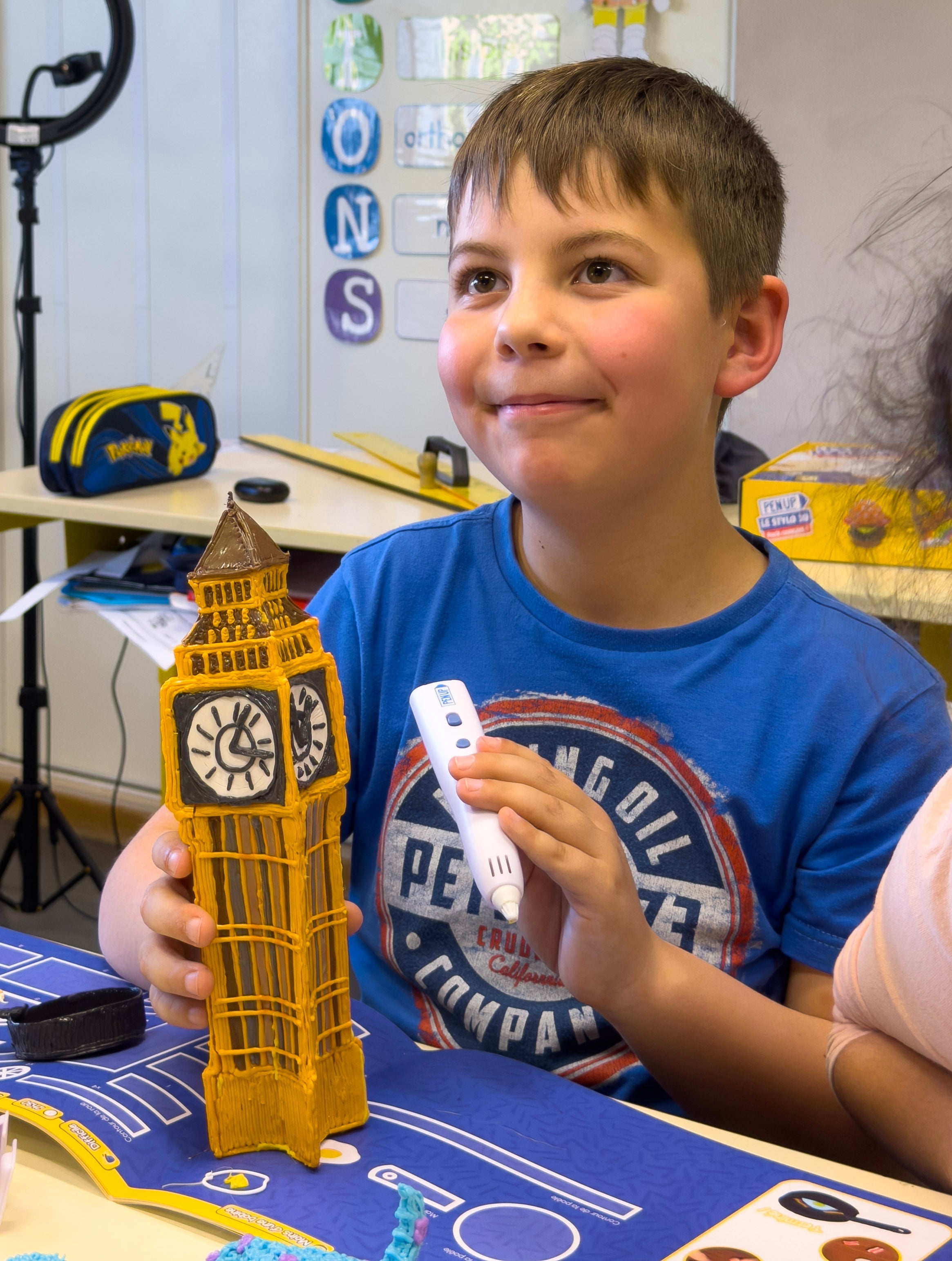
No, as long as you choose a low-temperature pen designed for children. The Pen'Up 3D pen, designed for children aged 6 and up, maintains a tip surface temperature of 35 °C (95 °F)—a value verified by a third-party laboratory—posing no risk of burns. High-temperature pens (PLA/ABS), on the other hand, heat up to 190–240 °C (374–464 °F) and should be reserved for teenagers and adults.
When talking about the dangers of a 3D pen, we are almost always talking about one thing: does it burn? And that is where the distinction is crucial. There are two main families of 3D pens, designed for completely different uses.
| Criterion | Low-temperature pen (Pen'Up 3D) | High-temperature pens (PLA/ABS) |
|---|---|---|
| Tip surface temperature | 35 °C (95 °F), verified by a third-party laboratory | 190 to 240 °C (374 to 464 °F) |
| Filament | Low-temperature PCL (internal melting: approx. 60 °C / 140 °F) | High-temperature PLA or ABS |
| Target audience | Children aged 6 and up | Teens and adults |
| Risk of burns from touching the tip | No risk of burns: the tip stays cool | Direct contact should be avoided |
| Standards | CE compliant, EN71 tested | Varies depending on the model |
In other words: a 3D pen is not dangerous by nature. The choice of model makes all the difference. A pen designed and tailored specifically for children is built precisely to prevent any risk of burns.
Why a kids' 3D pen doesn't burn: 35 °C versus 190 to 240 °C
The tip of the Pen'Up 3D maintains a surface temperature of 35 °C (95 °F), which is below human body temperature (37 °C / 98.6 °F). The skin only starts to feel uncomfortable heat around 45 °C (113 °F): at 35 °C, a child touching the nozzle area barely feels any warmth, like holding a slightly lukewarm mug. It is an entirely different world from the 190 to 240 °C (374 to 464 °F) reached by high-temperature pens.

In contrast, a high-temperature pen at 200 °C (392 °F) or more is comparable to a hot baking oven. The difference is not subtle: it is an entirely different category. This is precisely why low temperature is the number one criterion for a 3D pen intended for children.
The filament also differs fundamentally. Our Fil'Up filament is a low-temperature PCL, which melts inside the pen at only around 60 °C (140 °F), unlike high-temperature PLA and ABS. In practice: the tip stays cool, with no hot parts, and the filament hardens quickly upon contact with air so children can see their creation take shape in just a few seconds.
3D pens and child safety: the questions that truly reassure
With temperature covered, here are the other questions parents ask us most often, along with our honest answers. They are based on verifiable facts: a 35 °C (95 °F) surface temperature measured by a third-party laboratory, CE compliance, EN71 testing, and a 4.88/5 rating based on 2,300 verified reviews.
Can my child get burned by touching the tip?
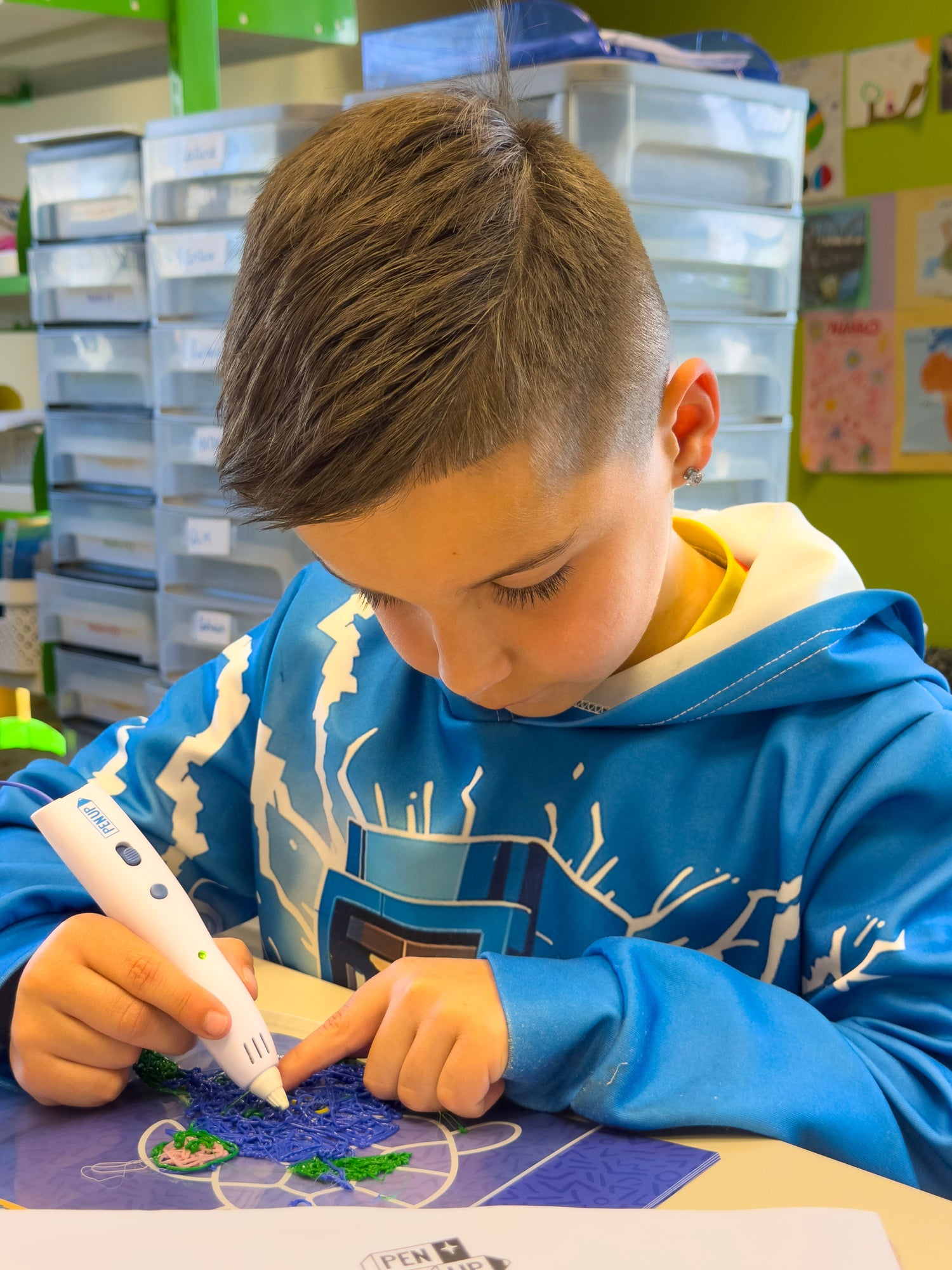
On a low-temperature pen like the Pen'Up 3D, the tip surface temperature stays at 35 °C (95 °F), a value verified by a third-party laboratory: no risk of burns. Children can bring their hands near the filament nozzle with total peace of mind. This is the most common feedback we receive from relieved parents.
And is the filament that comes out burning hot?
The melted filament comes out warm and hardens very quickly. Low-temperature PCL remains neutral: no smoke, no strong odor. This is one of the clear differences compared to low-end models or high-temperature pens. Use only official Fil'Up spools (10 m, Ø 1.75 mm): unsuitable filament can clog or damage the pen.
At what age is it safe from burn risks?
The Pen'Up 3D pen is designed for children aged 6 and up. Under 6 years old, adult guidance is still recommended—not because of burn hazards, but because fine motor skills are not yet fully developed to hold the pen independently. The size is also tailored to small hands, featuring 2 speed modes for a gentle start.
Can they use it without me in the room?
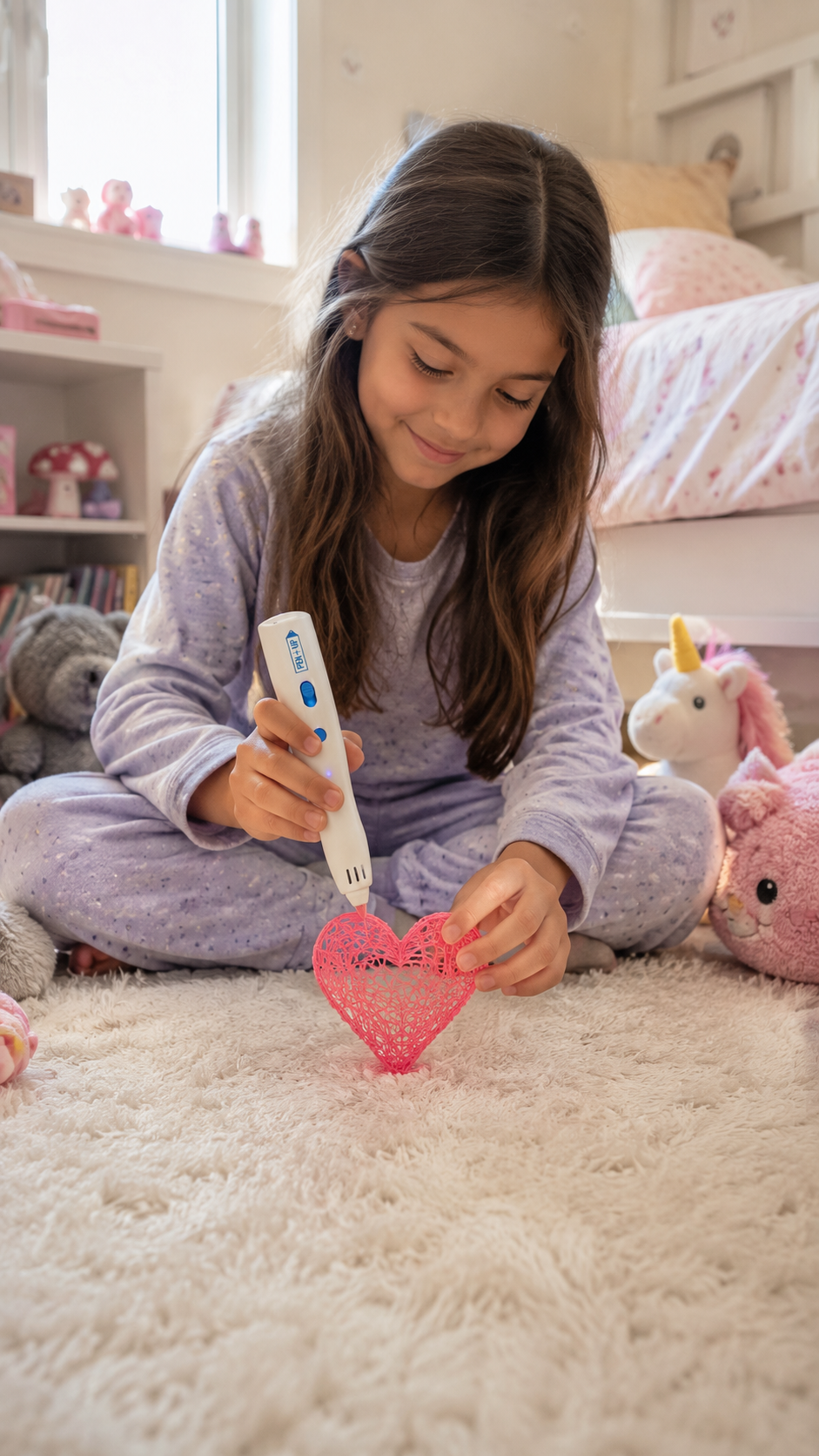
Thanks to the low temperature, a properly chosen 3D pen for kids is an activity your child can enjoy with complete peace of mind. As with any creative activity, a watchful eye from time to time is plenty: there is no need to stand right beside them constantly to prevent burn risks. The pen enters automatic sleep mode when the child takes a break and is cordless during drawing (about 1 hour of battery life, USB-C charging).
Beyond temperature: how to recognize a reliable 3D pen?
A reliable 3D pen states a precise surface temperature (35 °C / 95 °F for the Pen'Up 3D, verified by a third-party laboratory), CE compliance and EN71 testing, a clearly identified low-temperature filament (PCL), and accessible customer support. Anonymous, ultra-cheap marketplace models rarely meet these criteria.

Beware of low-end models: often lacking French instructions, customer support, and sometimes vague about the actual temperature. To buy with confidence:
- Make sure the manufacturer clearly specifies a precise surface temperature, rather than a vague "does not get hot."
- Opt for a low-temperature filament (PCL), which is neutral and has no strong odor.
- Check for CE compliance and EN71 testing (the European toy safety standard).
- Choose a brand that provides customer service and user manuals in French.
On these points, Pen'Up 3D is a French brand (the pen is designed in France): customer support based in Montauban with a response within 24 hours, clear instructions, a lifetime warranty (commercial warranty), and a rating of 4.88/5 based on 2,300 verified reviews.
In summary: dangerous or not?
A high-temperature 3D pen (190 to 240 °C / 374 to 464 °F) can burn: it is not made for children. A kids' low-temperature 3D pen, such as the Pen'Up 3D with its 35 °C (95 °F) tip verified by a third-party lab, is designed specifically to be free from burn risks while providing a truly engaging, screen-free creative activity for ages 6 and up.
What the research says. Once safety is established, many parents wonder if this activity has a place in their child's daily routine. The report "Children and Screens: In Search of Lost Time," submitted to the French President in April 2024 (Commission of experts on youth screen exposure, 2024), estimates that 7 to 19-year-olds spend an average of over 3 hours a day in front of screens and recommends moderate exposure after age 6 to leave room for a variety of activities. Its authors also urge for an increase in alternatives to screen time. Creative and hands-on crafts, including 3D pens, are among these valuable alternatives.
And to remain honest about the benefits: a systematic review published in the Journal of Science and Medicine in Sport (van der Fels et al., 2015) concludes that the link between motor skills and cognitive skills is real for the most complex tasks, but remains uncertain or insufficiently demonstrated in many cases. Research therefore calls for caution rather than definitive conclusions. A 3D pen is above all a creative and hands-on activity that children love, not a guarantee of academic progress.
If you want to start with a safe, complete set, the easiest choice is the Pen'Up 3D Complete Pack (€99.99): the low-temperature pen, stencils, age-specific guidebooks, and everything needed to start creating from day one. To learn more about choosing a pen, read our complete guide to kids' 3D pens, and to compare all options (standalone pen at €49.99, Discovery Pack at €69.99, Fil'Up refills from €4.99), explore the Pen'Up 3D shop.
FAQ: 3D pens and child safety
Is a 3D pen dangerous for a child?
Not if it is designed for children. The risk comes from high-temperature pens, whose tips reach 190 to 240 °C (374 to 464 °F). A low-temperature kids' 3D pen like the Pen'Up 3D maintains a tip surface temperature of 35 °C (95 °F), verified by a third-party laboratory: completely safe from burn risks.

Can a 3D pen burn you?
A high-temperature pen, yes: from 190 to 240 °C (374 to 464 °F), it can cause burns. A 3D pen for children, no: its tip stays at 35 °C (95 °F), which is below body temperature. Children can get close to it without any risk of burns.
What is the temperature of a kids' 3D pen?
On the Pen'Up 3D pen, the surface temperature of the tip is 35 °C (95 °F), verified by a third-party laboratory. This is made possible by the low-temperature PCL filament (internal melting around 60 °C / 140 °F), unlike high-temperature PLA or ABS filaments.
Can my child use it without constant supervision?
Thanks to the low temperature, it is an activity that children aged 6 and up can do with complete peace of mind. A watchful eye from time to time is enough, without the need to stand right beside them constantly for fear of burns.
Is the filament coming out of the pen burning hot or toxic?
The low-temperature filament comes out warm and hardens quickly. The PCL used remains neutral: no smoke or strong odor, unlike some low-end models. Use only official Fil'Up spools to protect the pen.
At what age is a 3D pen suitable?
The Pen'Up 3D is designed for children aged 6 and up. Before age 6, adult guidance is recommended to help get started.