

Updated on July 19, 2026
"What is the right age to give a child a 3D pen?" This is probably the most common question before buying this gift, and naturally so: you want to be sure the child will know how to use it, without feeling frustrated or left behind. The short answer: starting at age 6, with a true "sweet spot" between 6 and 10 years old. But the ideal age also depends on what your child enjoys doing and their level of independence. Here is a clear, age-by-age guide to giving the right 3D pen at the right time.
At what age can a child use a 3D pen?
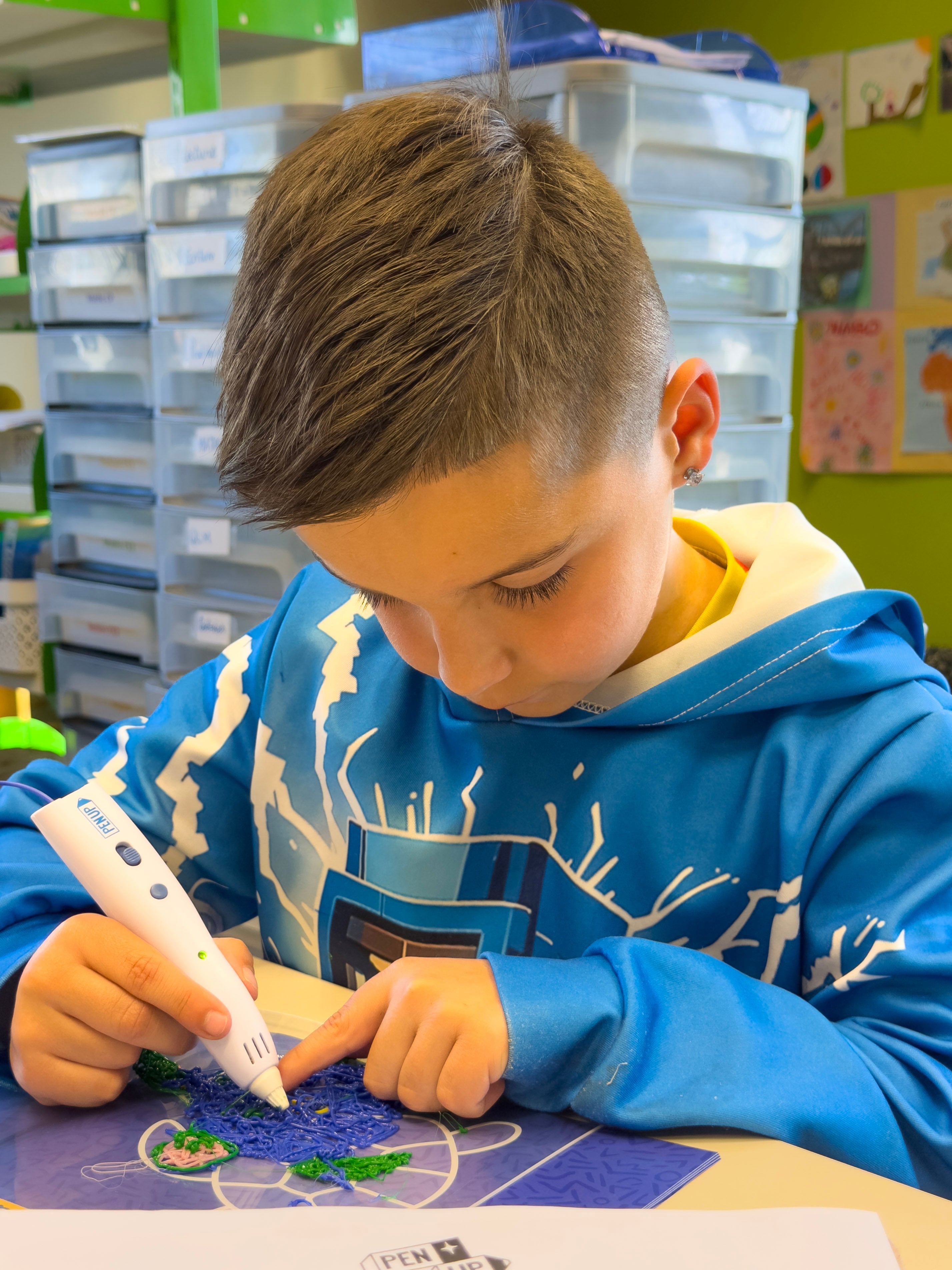
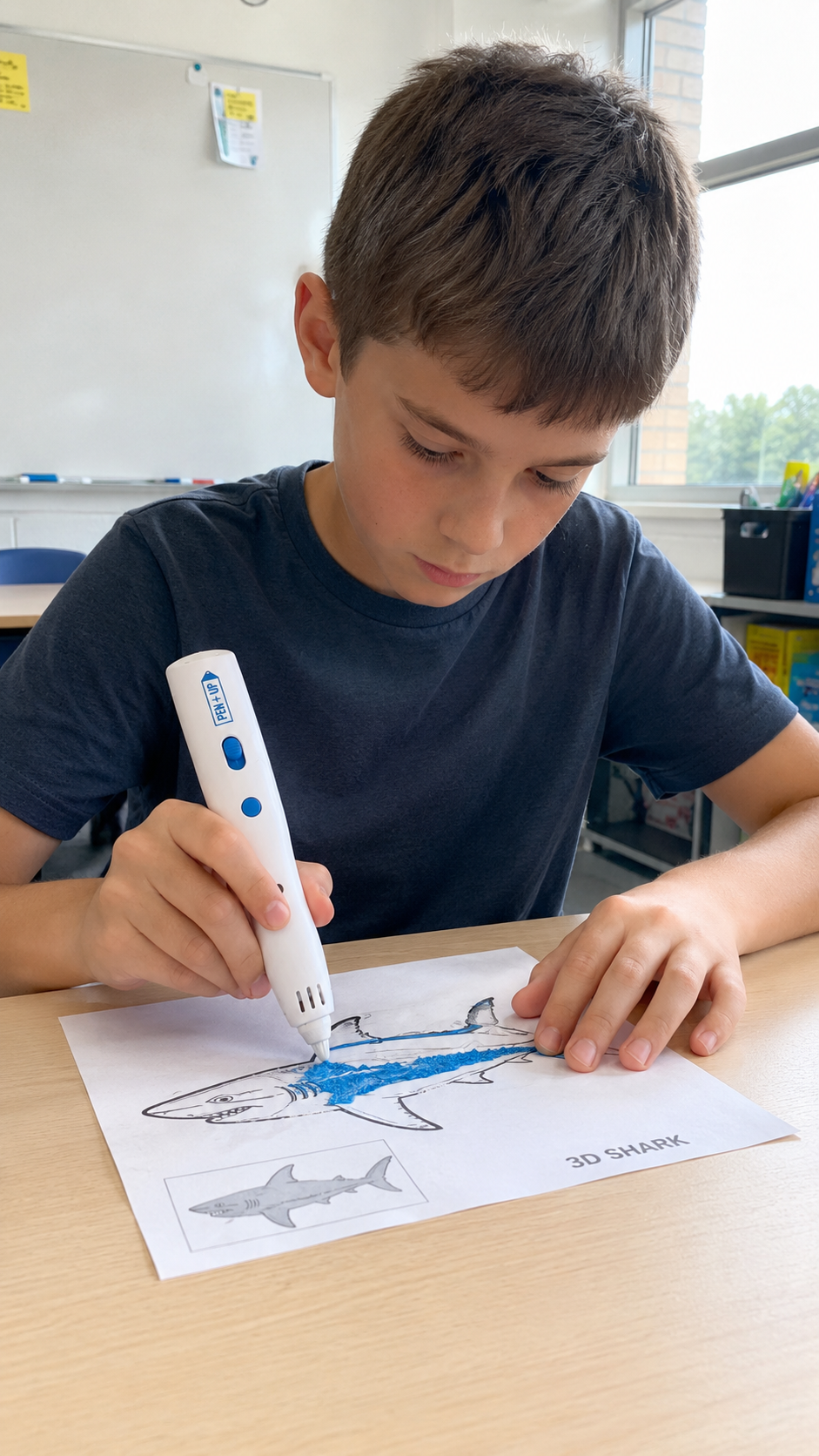
A child can use a low-temperature 3D pen independently from age 6. This is the recommendation for the Pen'Up 3D, designed for children aged 6 and up: the tip surface stays at 35°C (95°F), verified in third-party lab testing, with no burn hazard. The minimum age is therefore based on the child's motor skills and attention span, not on heat danger.
Why age 6 specifically? Because it's when several key milestones come together:
- Fine motor skills are developed enough to hold the pen and press the button without difficulty.
- The child can follow simple instructions and hold their focus long enough to complete a small creation.
- The desire to create freely is at its peak: at age 6, kids love watching "their" flower or "their" name come to life in 3D.
This fine motor skill milestone is significant. It's not just about playtime comfort: research on large cohorts of children (Grissmer et al., 2010, published in Developmental Psychology, link) found that fine motor skills at school entry are statistically associated with later achievement in reading and mathematics. This represents an observed correlation, not proof that any single hands-on activity boosts academic performance, and the study focuses on fine motor skills in general, not 3D pens. However, it confirms that around age 6, precise hand movements are at the heart of child development.
And on the safety side, age is not an obstacle: the Pen'Up 3D is a low-temperature model, CE-compliant and EN71-tested, with a tip that stays cool (around 35°C / 95°F on the surface) and no hot parts. The minimum age is therefore not dictated by burn risks, but by the child's ability to handle the pen independently. Note: high-temperature 3D pens (PLA/ABS), whose nozzle heats to 190–240°C (375–465°F), belong to a different category suitable only for teens and adults.
Why are ages 6–10 the "sweet spot"?
Between ages 6 and 10, children can manage on their own within the first few minutes: they set up, create, and proudly show off the result. This is the age group that appears most frequently in the 2,300 verified reviews for Pen'Up 3D (average rating of 4.88/5 on Judge.me), and the age where the pen fully plays its role as a calm, screen-free creative activity.

At this age, the 3D pen ticks all the boxes of a great hands-on activity: creativity, fine motor skills, focus, and genuine pride in making things "for real." It's also the age when it becomes a real alternative to screens: a hands-on activity that truly keeps them engaged.
What the research says: the report Children and Screens: In Search of Lost Time, submitted to the French President in April 2024 (link), estimates that 7- to 19-year-olds spend an average of over 3 hours a day in front of screens and recommends moderate exposure after age 6 to leave room for varied activities. Its authors also call for expanding screen-free alternatives: arts and crafts, including 3D pens, are among these viable alternatives.
What can a child make depending on their age?
From age 6, children progress in stages: stencils and tracing around ages 6–7, freeform creations around ages 8–10, and 3D objects and scale models from age 11 up. Before age 6, the activity is still possible with an adult guiding their hand. The table below outlines these stages across 4 age groups.
| Age | What the child can make | Independence |
|---|---|---|
| Under 6 years old | Choosing colors and shapes, guided hand | With an adult |
| Ages 6–7 | Stencils, line tracing, small raised designs | Independent after a short learning curve |
| Ages 8–10 | Freeform creations: characters, jewelry, decorations | Fully independent |
| Ages 11+ | 3D objects, models, technical assemblies | Independent, seeks challenges |
Ages 6–7: first creations
At this age, it's best to start with the most rewarding projects: following a stencil, tracing lines, making small raised patterns. Children need quick wins to stay engaged, and stencils are perfect for that. A kit with templates to copy avoids the blank-page syndrome and gets the excitement going from day one.
These hands-on activities are more than just a pastime: research conducted with preschool children (Suggate, Stoeger, and Pufke, 2017, Early Child Development and Care, link) observed that hands-on play and activities go hand in hand with the development of fine motor skills. While these studies describe a general trend and do not focus on any specific toy, they align with what parents observe: at this age, children need to work with their hands.
Ages 8–10: independence and imagination
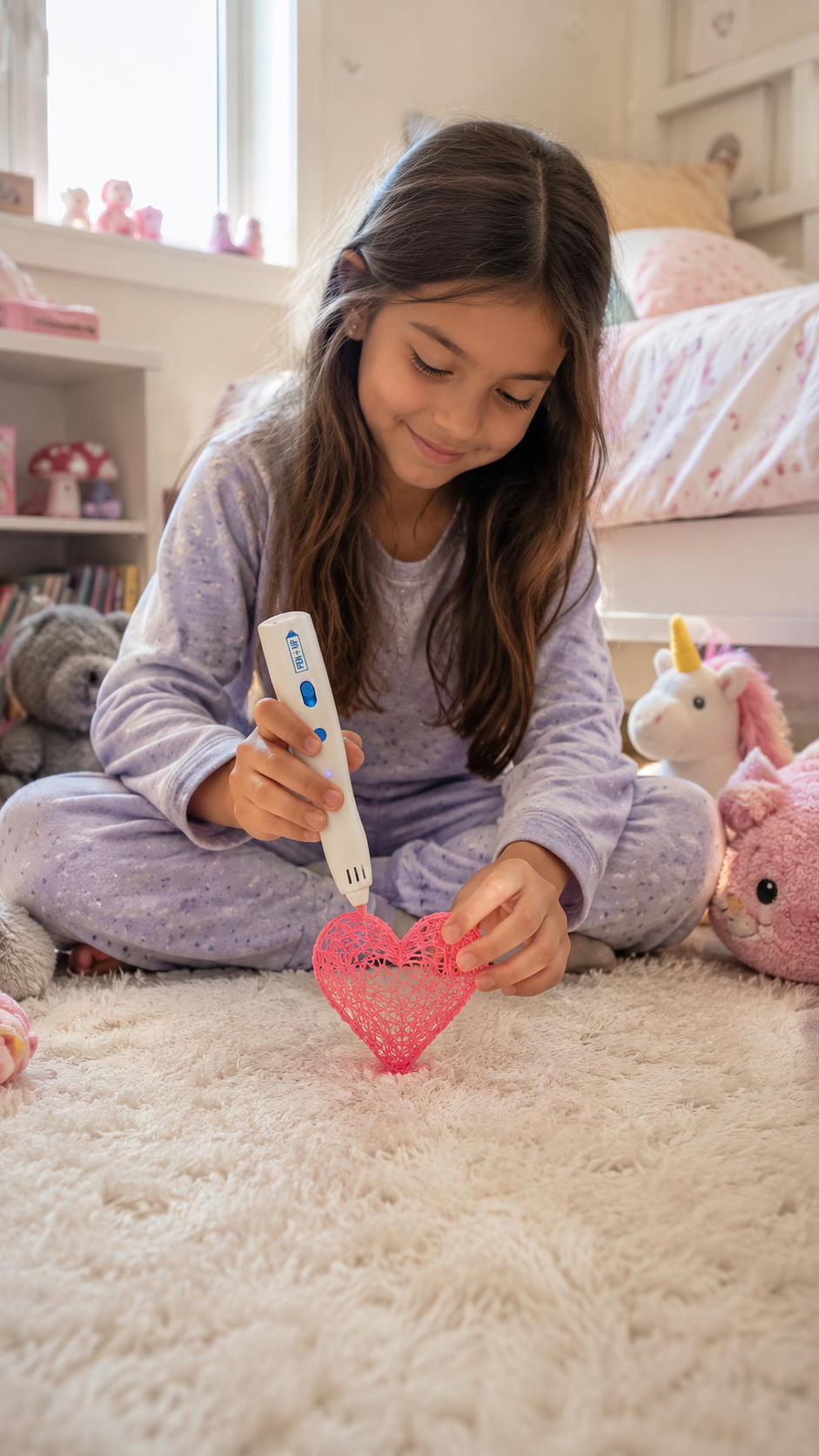
This is the golden age for 3D pens. Children transition from stencils to their own ideas: characters, jewelry, decorations, and small items they invent. Fine motor skills are well established, focus holds strong, and the pride of making things "for real" is immense. This is often the age when the pen turns into a true passion.
Ages 11+: 3D creations
The pen continues to appeal, but things step up a notch: 3D objects, models, assemblies, more technical creations. The child looks for a challenge and focuses on details and finishing touches. At this age, what matters most is having enough material (filament spools, colors) to avoid limiting their creativity.
Can you give a 3D pen to a child under 6?
Yes, provided an adult supervises each session. Safety-wise, a low-temperature model like the Pen'Up 3D keeps a surface tip temperature of 35°C (95°F), with zero risk of burns. What children under 6 lack is the fine motor skills and patience needed to create completely on their own. The best approach: the adult guides the hand, and the child picks the colors and shapes.

This need for guidance before age 6 also aligns with health guidelines for younger children: the WHO has recommended since 2019 (link) zero screen time before age 2 and no more than one hour per day between ages 2 and 4, prioritizing active play and sleep. This is one of the reasons why most hands-on activities, including 3D pens, are aimed at older children: before age 6, toddlers mainly need to move, sleep, and play freely.
It is a wonderful shared moment, provided you don't expect the child to do it all alone.
How to choose the right pen based on age?
Three criteria apply to all ages starting from 6 years old: a low-temperature PCL-type filament (internal melting around 60°C / 140°F, nozzle tip surface around 35°C / 95°F), getting the hang of it in minutes, and plenty of content to start right away. The pen alone costs $49.99; the Complete Pack at $99.99 adds stencils, templates, and a stock of filament spools.
A standalone pen without stencils or templates quickly loses its charm; a complete kit keeps the creative spark alive over time. Don't forget refills: use only official Fil'Up spools (low-temperature PCL, 10 m, 1.75 mm dia., from $4.99), as incompatible filament can clog or damage the pen.
That is why, for a first 3D pen, the easiest choice is the Pen'Up 3D Complete Pack: the low-temperature pen, stencils, templates, and a generous supply of spools so the child has everything to start creating on day one, whatever their age. To explore all selection criteria, also read our complete guide to 3D pens for kids.
FAQ: what age should you give a 3D pen?
What age is a 3D pen suitable for?
Starting at age 6 for most kids' 3D pens, including the Pen'Up 3D. This is the age when fine motor skills and focus allow children to create independently. The ideal age range is between 6 and 10 years old.

Can a 6-year-old child really use it alone?
Yes. A good 3D pen is easy to master in just a few minutes, and from age 6, children can follow a stencil and make their first creations on their own. The included stencils and templates make getting started much easier.
Is a 3D pen also suitable for older kids (ages 10+)?
Absolutely. After age 10, children move on to more ambitious projects: 3D objects, scale models, and complex assemblies. The pen grows with them, provided they have enough filament spools and colors.
Can it be given to a child under 6?
Yes, but with adult supervision. Before age 6, fine motor skills aren't quite ready for fully independent use: the adult guides the hand, while the child chooses shapes and colors.
Does age make a difference for safety?
No. The Pen'Up 3D is a low-temperature model whose tip stays around 35°C (95°F) on the surface—a temperature verified by third-party laboratories—with no burn hazard, regardless of age. The minimum age depends on the child's independence, not on heat.
Which 3D pen should you choose for a first purchase?
For a first pen, choose a complete kit with stencils, templates, and filament spools, like the Pen'Up 3D Complete Pack ($99.99): the child has everything needed to start creating from day one, without frustration or blank-page syndrome.