

Updated on July 19, 2026
Should you choose a low-temperature or a high-temperature 3D pen for your child? Short answer: for a child aged 6 or older, choose a low-temperature pen, with a nozzle surface temperature around 35 °C (95 °F) and no burn risk. High-temperature pens (190 to 240 °C / 374 to 464 °F) should be reserved for teens and adults. When comparing models online, this distinction is far more important than it seems: it separates two completely different worlds. We explain everything clearly so you can choose with full confidence.
Low-temperature vs. high-temperature 3D pen: What is the difference?
A low-temperature 3D pen melts low-temperature PCL filament (internal melting around 60 °C / 140 °F) and maintains a nozzle surface temperature around 35 °C (95 °F): this is the category designed for kids aged 6 and up. A high-temperature 3D pen melts PLA or ABS filaments between 190 and 240 °C (374 and 464 °F): its nozzle becomes burning hot, making it suitable for teens and adults.
All 3D pens work on the same principle: they melt a plastic strand (the filament) that extrudes through the nozzle and hardens upon contact with air. The difference lies in the temperature at which the plastic melts, and therefore how hot the nozzle gets.
| Criterion | Low-temperature 3D pen (cool) | High-temperature 3D pen (hot) |
|---|---|---|
| Filament | Low-temperature PCL | PLA / ABS |
| Melting temperature | around 60 °C (140 °F) (inside the pen) | 190 to 240 °C (374 to 464 °F) |
| Nozzle | surface temperature around 35 °C (95 °F), stays cool to the touch | burning hot |
| Target audience | kids ages 6 and up | teens and adults |
| Burn risk | no burn risk (35 °C / 95 °F verified by a third-party laboratory on the Pen'Up 3D) | direct contact can cause burns |
The word "cool" is a simplification: the nozzle is not icy, it simply stays warm enough not to burn little fingers. For a child, that makes all the difference.
Why is low temperature the right category for children?
Because at a 35 °C (95 °F) surface temperature, the nozzle is below human body temperature: children can touch it without risk of burns. On the Pen'Up 3D, this 35 °C value was verified by a third-party laboratory, and the pen is CE-compliant and EN71-tested. At 200 °C (392 °F) and above, it is comparable to a hot oven: direct contact can cause burns.

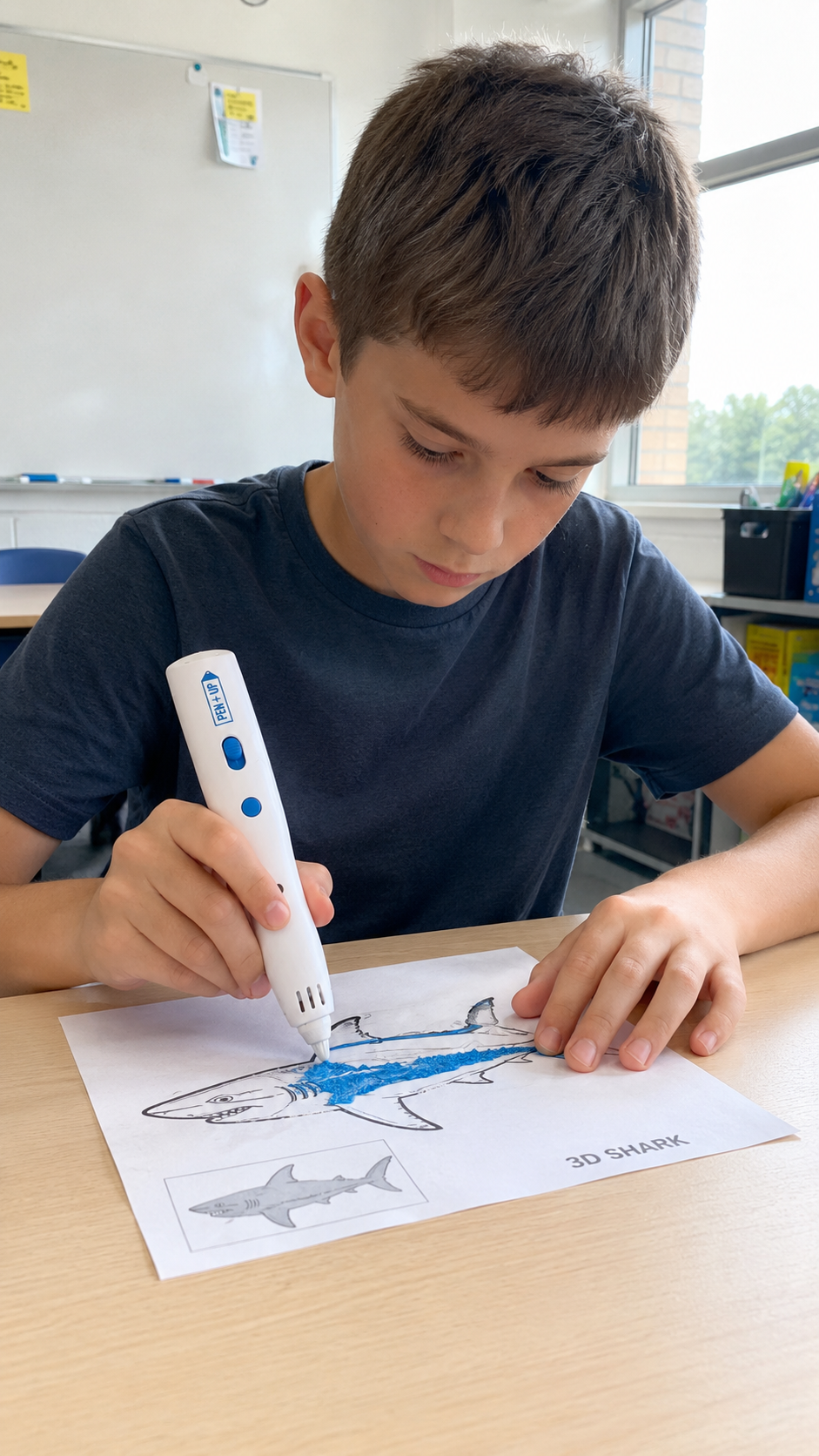
This is not a subtle difference; it is a completely different category. A low-temperature 3D pen is designed and crafted so that children can create with complete peace of mind, even when you are not right beside them. The nozzle stays cool to the touch, and there are no hot parts. This is why low temperature is, by far, the number one criterion for a 3D pen intended for young children.
Which filament for which pen: PCL vs. PLA/ABS?
The filament dictates the temperature: PCL melts gently at around 60 °C (140 °F) inside the pen and comes out warm, whereas PLA and ABS require 190 to 240 °C (374 to 464 °F). At Pen'Up 3D, Fil'Up refills are 10 m PCL spools with a 1.75 mm diameter, available from €4.99. Here again, the two worlds are opposites.
Low-temperature PCL (cool pen)
Our filament is a low-temperature PCL. It melts gently, comes out warm, hardens quickly, and remains odorless and non-toxic: no fumes, no strong odors. It is exactly what you want in a child's hands. An important note: use only official Fil'Up spools (10 m, 1.75 mm diameter), as unsuitable filament can clog or damage the pen. They are easy and affordable to restock, starting from €4.99.
High-temperature PLA / ABS (hot pen)
Pens for adults use PLA or ABS, which only melt at high temperatures. These filaments allow for more rigid and technical creations, but require a burning-hot nozzle and sometimes produce stronger odors. They are excellent tools… for teens or adults, not for a 7-year-old child.
So, low or high temperature: which one should you choose depending on the use?
For a child aged 6 or older, choose a low-temperature 3D pen: a nozzle surface temperature around 35 °C (95 °F), no burn risk, easy grip, and neutral filament. For a teen or DIY adult, a high-temperature pen (190 to 240 °C / 374 to 464 °F) may be suitable, provided it is used out of children's reach.

- For a child (ages 6 and up): a low-temperature (cool) 3D pen, without hesitation. Safety, easy handling, neutral and affordable filament.
- For a teen or DIY adult: a high-temperature pen may be suitable, provided you accept the hot nozzle and keep it out of reach of young children.
Good news: whichever category you choose, the activity itself is well worth it. A meta-analysis of 217 studies published in Psychological Bulletin (Uttal et al., 2013, link) shows that spatial skills (visualizing 3D objects, mentally rotating them) improve with practice and that these gains last over time. Manipulating and building 3D objects, as done with a 3D pen, is among the activities that help build these skills.
For a creative gift for a child—for Christmas or a birthday—the choice is clear: choose the low-temperature 3D pen. And to avoid the frustration of a "pen only" kit that runs out of filament quickly, a complete set is the best option.
Where to start with low-temperature 3D pens?
The simplest choice is the Pen'Up 3D Complete Pack at €99.99: the low-temperature pen (nozzle around 35 °C / 95 °F), stencils, templates, and a generous supply of filament spools to start creating on day one. The standalone pen is also available for €49.99, and the Discovery Pack for €69.99.
It is also, quite simply, a hands-on activity that offers a break from screens. The "Children and Screens" report submitted to the French Presidency in April 2024 (link) recommends moderate screen exposure after age 6 to leave room for varied activities, and its authors encourage offering alternative activities. 3D drawing is one of those great alternatives.
Pen'Up 3D is a French brand, designed in France, with customer support based in Montauban responding within 24 hours, a lifetime warranty (commercial warranty, free replacement), and a rating of 4.88/5 from over 2,300 verified reviews. Practical features: about 1 hour of battery life, cordless while drawing, USB-C recharging (usable while charging), and automatic sleep mode. To explore all selection criteria, also read our complete guide to 3D pens for kids.
FAQ: Low-Temperature vs. High-Temperature 3D Pen
What is the difference between a low-temperature and a high-temperature 3D pen?
A high-temperature 3D pen melts PLA or ABS filaments between 190 and 240 °C (374 and 464 °F): its nozzle is burning hot, making it a model for teens and adults. A low-temperature 3D pen melts low-temperature PCL filament and maintains a nozzle surface temperature around 35 °C (95 °F) without any burn risk: this is the category designed for kids.

Is a low-temperature 3D pen really cool?
Not ice-cold, but warm: the nozzle maintains a surface temperature of around 35 °C (95 °F) on the Pen'Up 3D (verified by a third-party laboratory), which is below human body temperature. Children can touch it without burning their fingers: there are no hot parts.
Which filament should you use for a low-temperature 3D pen?
Low-temperature PCL, which melts at around 60 °C (140 °F) inside the pen. It extrudes warm, hardens quickly, and stays neutral (no fumes, no strong odor), unlike high-temperature PLA and ABS used in adult pens. Use only official Fil'Up spools (10 m, 1.75 mm diameter): unsuitable filament can clog or damage the pen.
Which 3D pen should you choose for a child?
A low-temperature 3D pen, without hesitation. It is the category designed for kids aged 6 and up: a nozzle with a 35 °C (95 °F) surface temperature that does not burn, easy handling tailored to small hands, and affordable replacement filament.
Are refills for a low-temperature pen expensive?
At Pen'Up 3D, Fil'Up refills (10 m PCL spools, 1.75 mm diameter) are available from €4.99: an easy and affordable consumable to restock. Always prefer official spools, as an unsuitable filament can clog or damage the pen.
Can a high-temperature 3D pen be suitable for a child?
It is not recommended. Between 190 and 240 °C (374 and 464 °F), the nozzle of a high-temperature pen can burn: these models are designed for teens and adults. For a child aged 6 or older, always opt for a low-temperature 3D pen with a nozzle that poses no risk of burns.