The 3D pen for children has become one of the most sought-after creative gifts, and one of the biggest sources of questions for parents. From what age? Does it burn fingers? Is it truly useful, or just another gadget abandoned within three days? This complete guide answers everything, simply, to help you choose the right 3D pen and give your child a genuine creative activity… away from screens.
What is a 3D pen for children?
A 3D pen looks like a large felt-tip pen, but instead of ink, it melts and extrudes a soft plastic filament that hardens within seconds upon contact with air. The result: the child no longer draws only on a sheet of paper — they draw in space. A flower, an animal, the Eiffel Tower, a raised name… anything becomes possible in just a few minutes.
The principle is simple, but not all 3D pens are equal. Those designed for adults heat up to very high temperatures (160 to 220 °C) and are not suitable for children. Those designed for younger users use a so-called "low temperature" filament that changes everything in terms of safety — this is the point we return to below, as it is the most important one.
From what age should you give a 3D pen?
Most 3D pens for children are recommended from age 6. That's the age when fine motor skills are sufficient to hold the pen and press the button without difficulty, while still keeping the desire to create freely.
Based on feedback from thousands of families, the "sweet spot" is between 6 and 10 years old: at this age, the child manages on their own from the very first minutes, which is exactly what you'd expect from a good creative activity. Under 6, adult supervision is still recommended. After 10, the pen continues to delight: children simply move on to more ambitious creations (3D objects, mechanisms, models).
Is a 3D pen dangerous? The real answer about temperature
This is the question every parent asks, and rightly so. The good news: a 3D pen designed for children has nothing in common with an adult model. On a children's pen, the tip does not heat up like a soldering iron: its surface temperature stays low, around 35 °C on the Pen'Up 3D pen, so the child can touch it without getting burned.
In practice, the child can place a finger near the filament outlet: they can barely feel any warmth. This is safety criterion number one, and by far the one that reassures parents the most in the reviews we receive. To help you at the point of purchase:
- Low-temperature filament (PCL type): essential for a child.
- "Non-burning" tip: check that the manufacturer states a precise surface temperature, not a vague "it doesn't get hot."
- No strong smell or smoke: a good low-temperature filament stays neutral.
A well-chosen 3D pen is therefore an activity your child can enjoy with complete peace of mind, even when you are not in the same room.
3D pens and screens: finally a creative activity that breaks away from all things digital
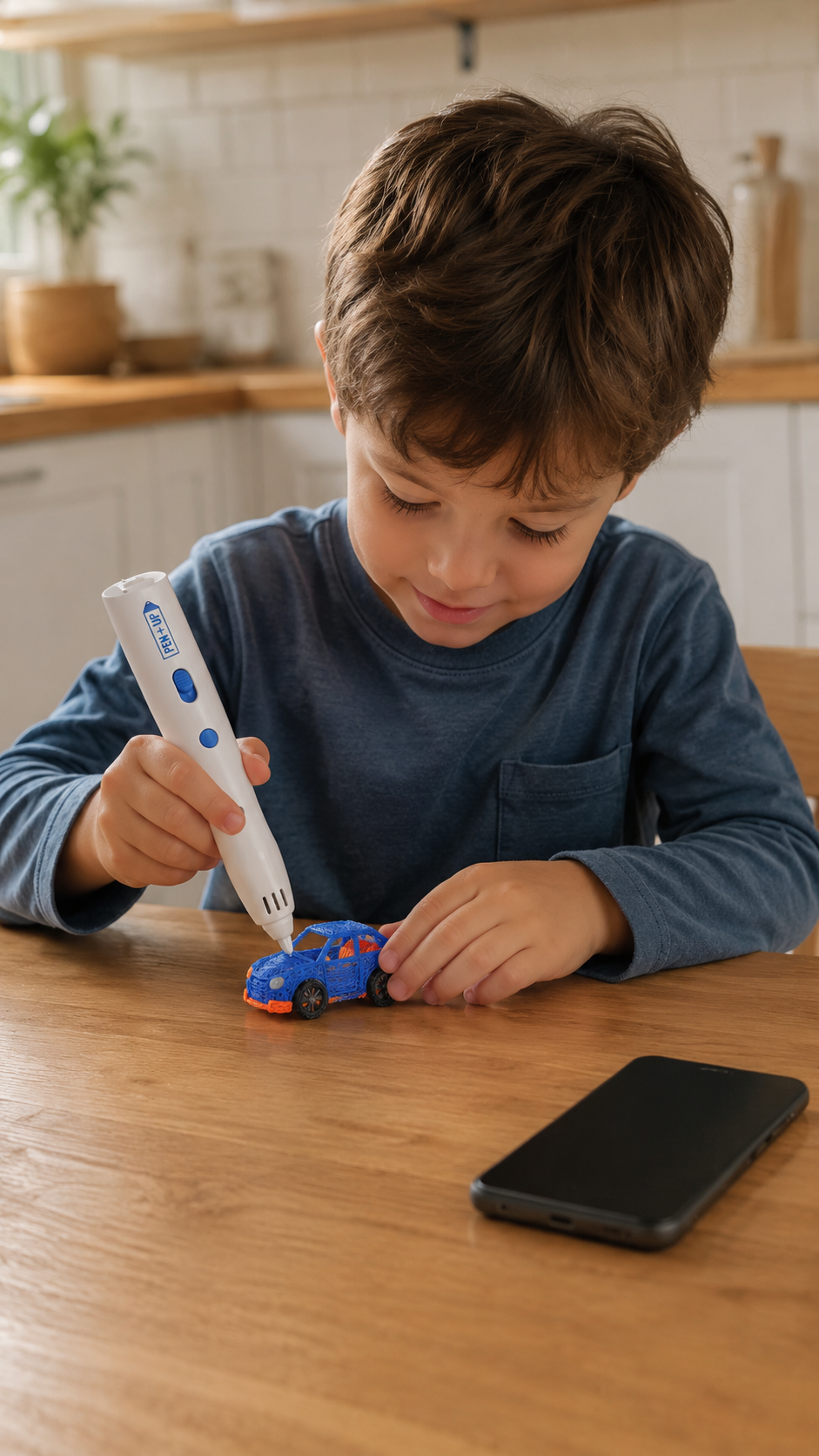
If you're looking for a way to keep your child entertained without screens, the 3D pen ticks all the boxes. It requires concentration, develops creativity and fine motor skills, and produces a tangible result that the child can show off, give away or collect. It's a "win" that many parents describe to us: the child absorbed in their creation… while the tablet stays on the shelf.
Beyond the home, the 3D pen has also found its place in an educational setting: Pen'Up 3D has been presented to the Académie de Toulouse, collaborates with the Canopé network and is used in schools to introduce children to three-dimensional creation. Proof that it's not just a gadget, but a genuine tool for expression.
How to choose the right 3D pen for your child? The 6 criteria
All 3D pens look alike in photos. Here's what really makes the difference in use, especially compared to low-end models sold cheaply on marketplaces.
1. Safety (surface temperature)
The non-negotiable criterion. Choose a pen whose tip stays cool to the touch (low surface temperature, around 35 °C). Be wary of models that remain vague about this figure.
2. Ease of use
A good 3D pen can be picked up in just a few minutes, from age 6, without a ten-page manual. A steady filament flow (without jamming) is what sets a good model apart from a frustrating one.
3. Refills: watch out for lock-in
Some brands lock you into expensive proprietary cartridges. At Pen'Up 3D, the filament is a standard consumable, easy to repurchase — no locked system forcing you to pay top price for every refill.
4. Battery life (and charging while in use)
Check the battery life and, above all, the ability to use the pen while it charges: this avoids the frustration of having to stop in the middle of a creation.
5. A French brand, with real customer service
Many "magic" pens sold online are anonymous products with no after-sales service or instructions in English. Pen'Up 3D is an award-winning French brand (Prix Audace 2023), with a customer service team in France and clear instructions: if something goes wrong, you have someone to turn to.
6. Included contents (stencils, models, spools)
A pen alone can quickly lose its appeal. A good set provides stencils, models to reproduce and several color spools so the child has everything they need to create from day one, and the motivation to keep going.
Why the 3D pen is such a hit with kids (and makes such a great gift)
The 3D pen combines what parents rarely find in a single gift: it's fun, creative, screen-free and long-lasting. Kids are proud of it — they show it off, give things away, and start all over again. It's also a gift that reassures grandparents: easy to use, safe, and always a hit at Christmas or for a birthday.
Where to start with Pen'Up 3D?
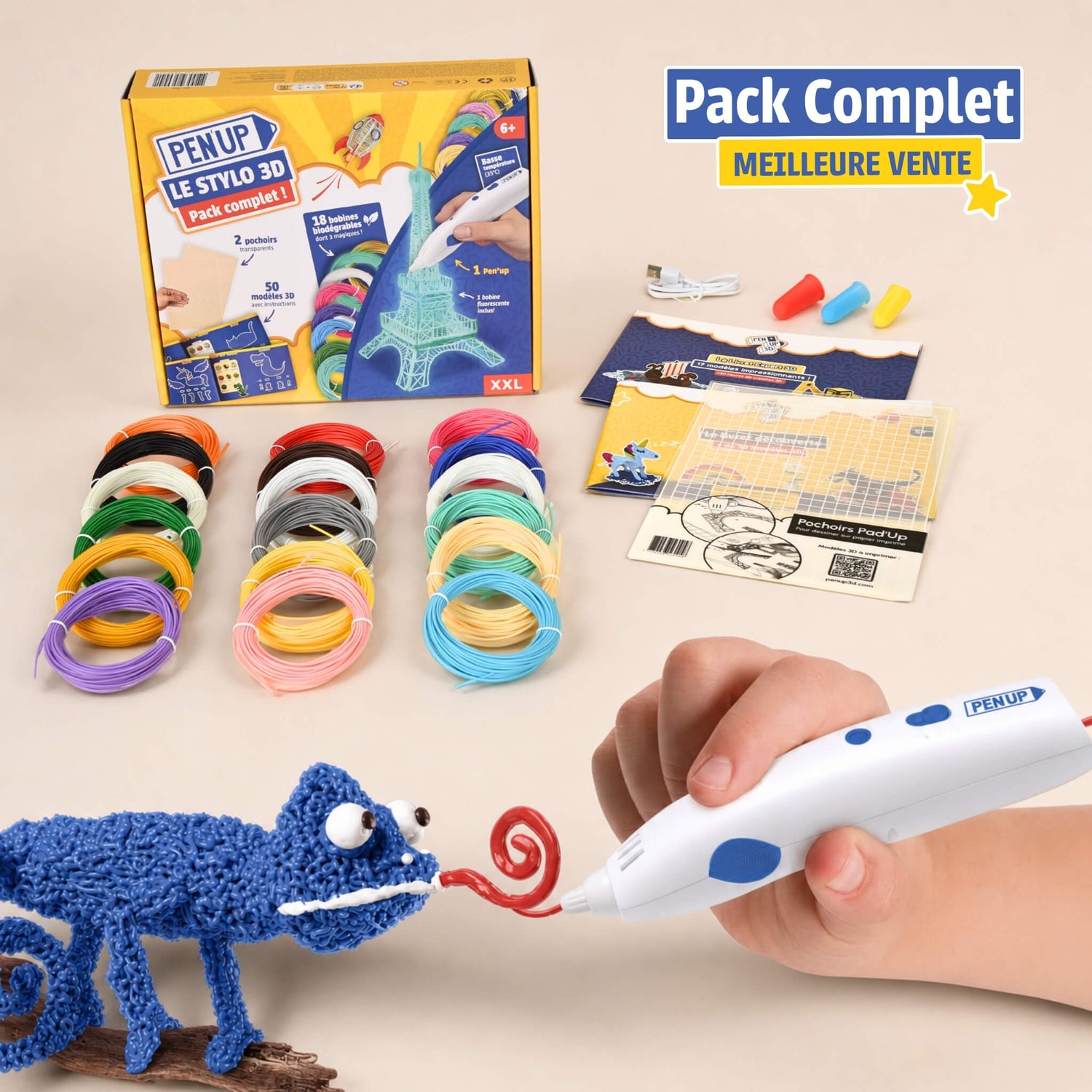
If you want to give a complete, ready-to-use 3D pen, the simplest option is the Pen'Up 3D Complete Pack: the low-temperature pen, stencils, models and a good stock of spools to get started right away. To give just the pen, check out the Pen'Up 3D Pen, and to compare all options (refills, accessories, kits), browse the full Pen'Up 3D shop.
FAQ, 3D pen for children
Does a 3D pen burn fingers?
No, not if it is designed for children. On a low-temperature pen like the Pen'Up 3D, the tip stays at a low surface temperature (around 35 °C): the child can touch it without getting burned. However, avoid pens designed for adults, which heat up to over 150 °C.
From what age?
From age 6. This is the recommended age for most children's 3D pens, with ideal use between 6 and 10 years old. Under 6, adult supervision is advised.
Is it complicated to use?
No. A good 3D pen can be picked up in just a few minutes, and most children create their first raised drawing on the very first day, without any help.
Do you need a screen or a computer?
None. The 3D pen is a 100% hands-on activity: that's precisely one of the reasons parents appreciate it as an alternative to screens.
Are refills expensive?
It depends on the brand. At Pen'Up 3D, the filament is a standard consumable, easy and affordable to repurchase, with no locked proprietary cartridge.
Is it a good gift?
Yes: creative, screen-free, long-lasting and easy to give, the 3D pen is one of children's favorite gifts for Christmas and birthdays, and one of those that truly stands the test of time.

Leave a comment
This site is protected by hCaptcha and the hCaptcha Privacy Policy and Terms of Service apply.