

Updated on July 19, 2026
The 3D pen in schools is increasingly finding its place in classrooms, and for good reason: it is one of the few tools that makes tangible what often remains abstract for children. Spatial geometry, group projects, fine motor skills: where a worksheet struggles to capture attention, the 3D pen sparks a desire to create. Here is a quick overview of why it appeals so much to both teachers and students.
Why do teachers love the 3D pen?
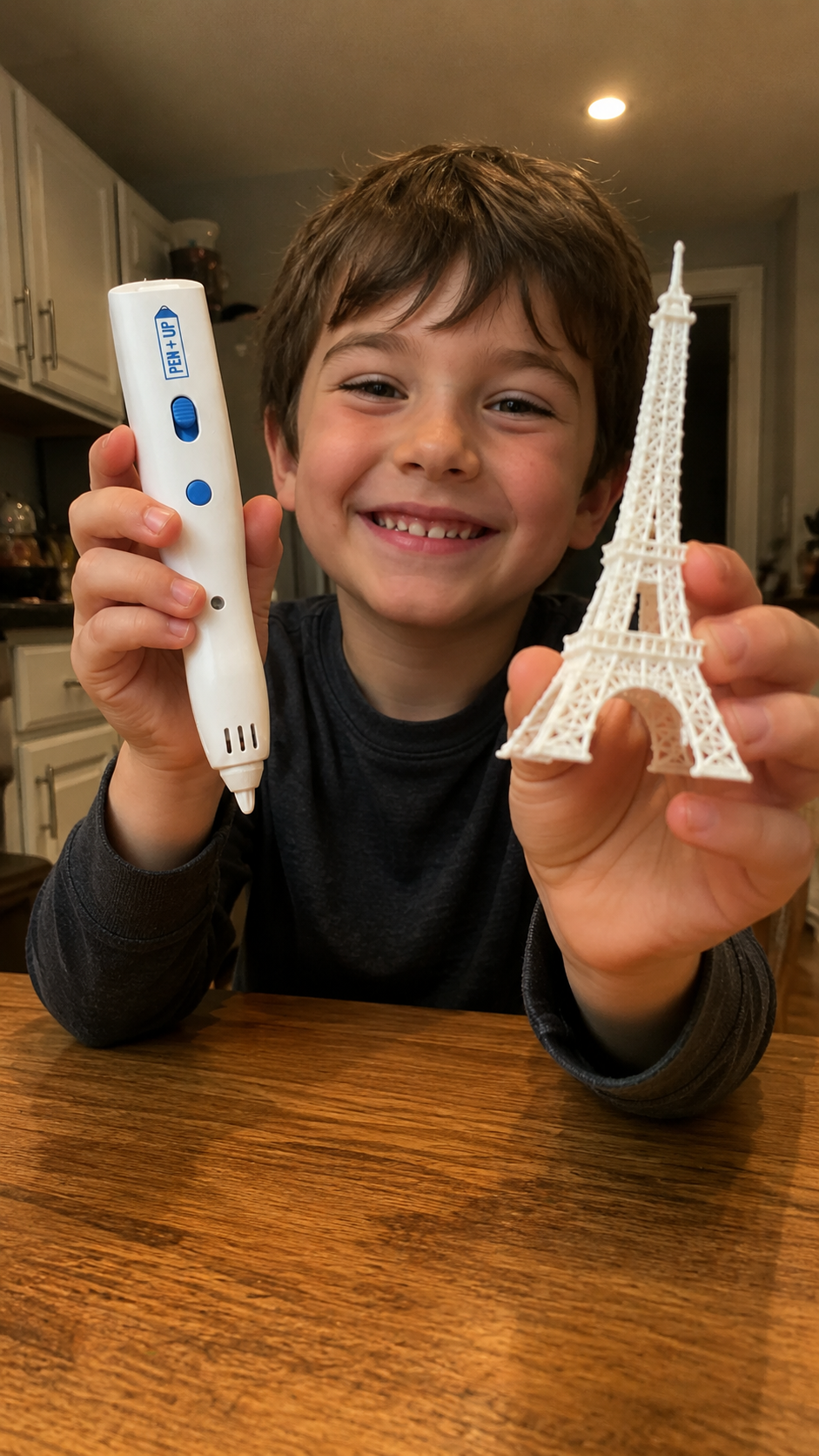
Because it is ready to use right away: no computer, no software, easy handling from age 6, and a whole class actively engaged in minutes. On a pen designed for children like the Pen'Up 3D, the surface temperature of the tip stays at 35 °C (third-party lab verified) with no risk of burns, allowing teachers to run workshops with complete peace of mind.
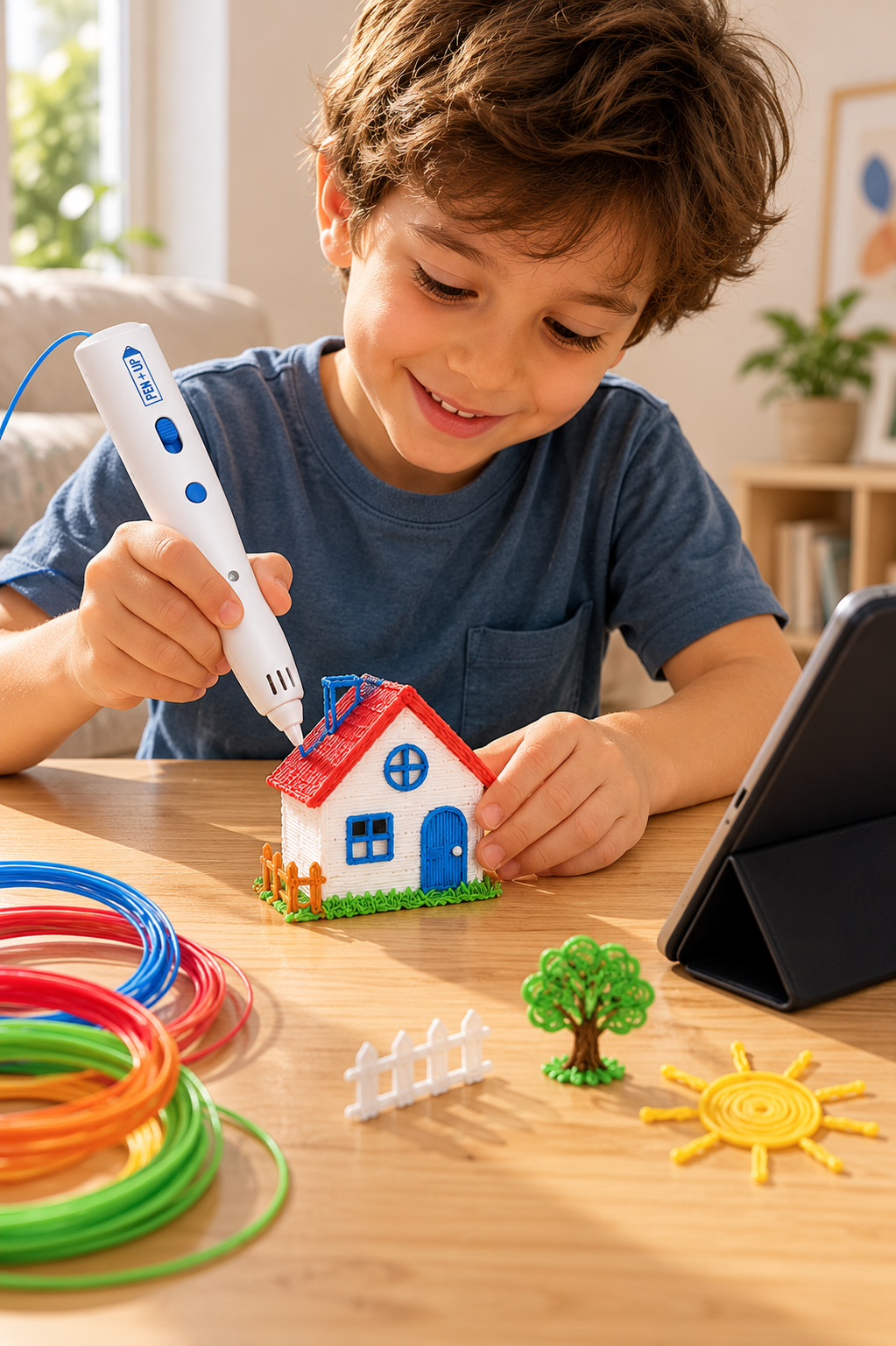
What sets the 3D pen apart from other "educational gadgets" is its ease of use. The student picks up the pen, extrudes a flexible plastic strand that hardens in seconds, and brings their idea to life in 3D. Wireless while drawing, with around 1 hour of battery life and USB-C charging, it fits perfectly into a classroom session format.
This educational value is rooted in a well-documented pedagogical principle: we retain what we do ourselves better. A comprehensive meta-analysis of 225 studies published in PNAS (Freeman et al., 2014, link) showed that science students score higher on exams and fail less often when learning actively rather than listening to lectures. While focused on higher education, many teachers apply the very same principle to younger learners.
As for standards and support, Pen'Up 3D is a French brand (designed in France): the pen is CE compliant and EN71 tested, customer support is based in Montauban with a 24-hour response time, and the pen is covered by a lifetime warranty (commercial warranty, free replacement). Families who use it give it a rating of 4.88/5 based on 2,300 verified reviews (Judge.me).
What does the 3D pen practically bring to students?
Four benefits stand out most frequently: spatial geometry becomes tangible, fine motor skills and focus are naturally developed, project-based learning comes to life, and teamwork empowers every student. All screen-free, across all age groups where these foundational skills are formed most rapidly: creativity, focus, and self-confidence.

Understanding geometry in a new way
It can be challenging for a child to picture a cube or a pyramid from a flat 2D drawing. With a 3D pen, students build the shape in 3D space, edge by edge. Concepts of volume, faces, and vertices become tangible: they are no longer just studied, they are built.
What research says: in a study published in the International Journal of STEM Education (Ng, Shi, and Ting, 2020, link), researchers compared 3D geometry learning using software versus 3D pens among 174 students aged 11 and 12 in Hong Kong. Five months after the lessons, students who had built their solids using 3D pens retained the concepts better—a result the authors link to the fact that they built the shapes with their own hands. An encouraging finding to be considered as a promising avenue rather than definitive proof.
The same team continued their observations across five primary school classrooms (Ng and Ye, 2022, link): by drawing edges and faces in space themselves, students connected physical actions and words to abstract concepts. The authors refer to this as "embodied" learning: when hands are involved, understanding follows more naturally.
Carrying a project through from start to finish
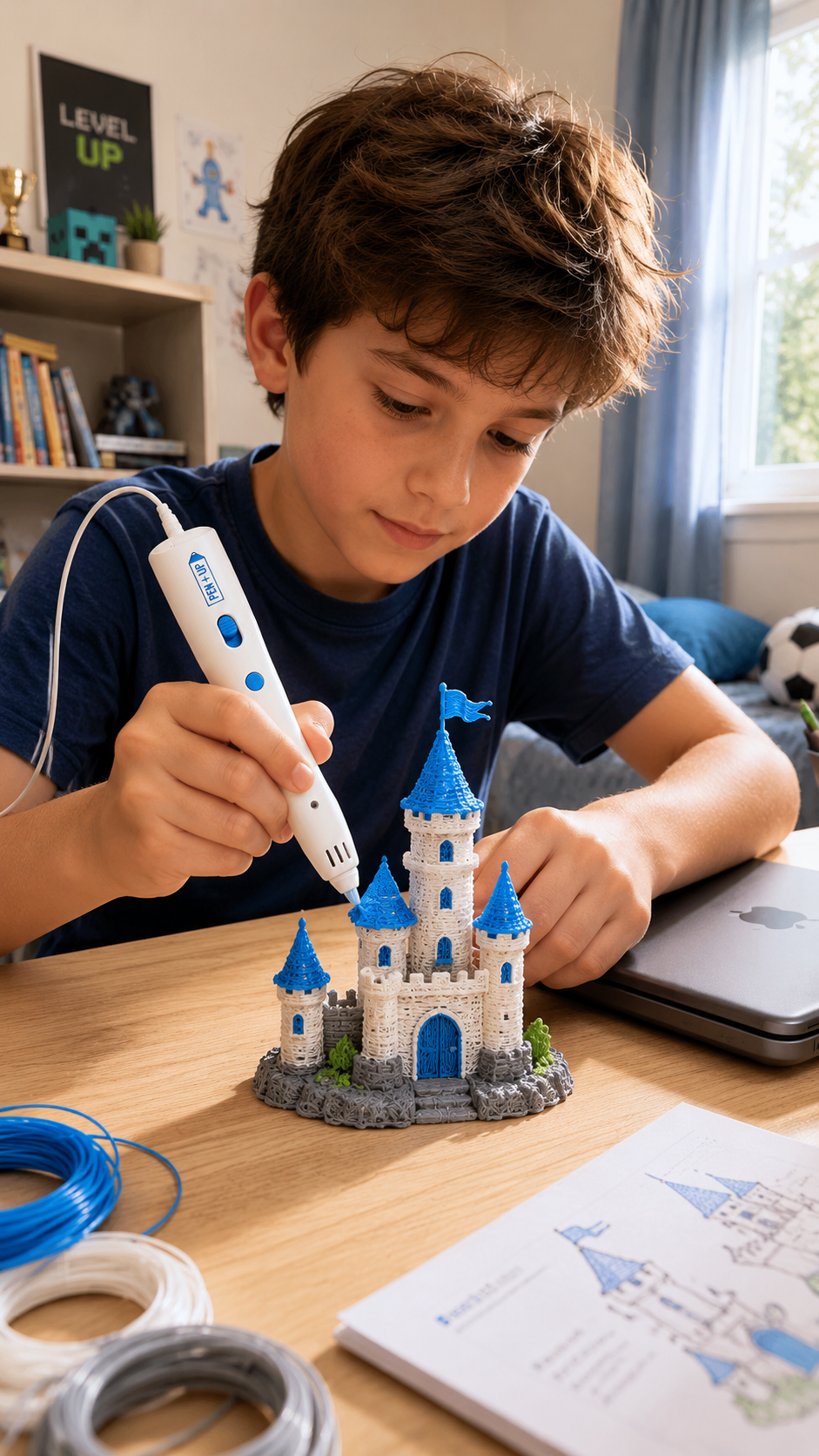
Designing a model, a character, or a scene requires planning, experimenting, and adjusting. The 3D pen is a fantastic tool for project-based learning: children learn to break down an idea into steps and persevere until they reach the final result—a skill that extends far beyond the activity itself.
Developing fine motor skills and focus
Guiding the pen, regulating speed, following a outline: the activity engages fine motor skills and hand-eye coordination. Many teachers also observe a calming effect: focused on their creation, children are calm and attentive, often more so than during other exercises.
Researchers are particularly interested in this development of fine motor skills: large-cohort studies on children published in Developmental Psychology (Grissmer et al., 2010, link) observed that fine motor skill levels at school entry are statistically associated with later success in reading and mathematics. This is an observed correlation, not direct causation: no hands-on activity can guarantee better grades, but it highlights why hands-on activities have an essential place in school.
Working in groups and empowering every student
A collective mural, a class scale model: the 3D pen is ideal for collaborative work. And because every child leaves with a tangible creation, the activity empowers even those students who feel less confident with writing or traditional drawing.
How to choose the right 3D pen for the classroom?
Four key figures say it all: a pen tip with a surface temperature that remains at 35 °C (no risk of burns), low-temperature PCL filament with an internal melting point around 60 °C, about 1 hour of battery life with USB-C charging, and a budget ranging from €49.99 for the standalone pen to €99.99 for the Complete Pack.
| Criteria to check | Concrete benchmark (Pen'Up 3D) |
|---|---|
| Tip temperature | 35 °C surface temperature, verified by third-party testing: tip stays cool, no hot parts |
| Filament | Low-temperature PCL (internal melting around 60 °C), official Fil'Up 10 m spools, Ø 1.75 mm |
| Recommended age | From 6 years old, suited for small hands, 2 speed modes |
| Battery life | Around 1 hour, wireless while drawing, USB-C charging, auto sleep mode |
| Standards and warranty | CE compliant, EN71 tested, lifetime warranty (free replacement) |
| Budget | Pen only €49.99, Discovery Pack €69.99, Complete Pack €99.99, refills from €4.99 |
Two points deserve particular attention:
- Avoid high-temperature pens: models using PLA or ABS filaments heat up to between 190 and 240 °C and should be reserved for teenagers and adults, not for a primary school classroom.
- Use only official Fil'Up spools: unsuitable filament can clog or damage the pen. Refills (10 m spools, Ø 1.75 mm) start at €4.99.
To equip a classroom or test the tool, the simplest option is the Pen'Up 3D Complete Pack (€99.99), which includes the pen, stencils, age-based project booklets (6+, 9+, 12+), and several spools in different colors.
What about at home?
What works in the classroom works just as well in the living room: many parents adopt the 3D pen as a screen-free creative activity from age 6, after discovering it at school or through word of mouth. The standalone pen is €49.99 and the Discovery Pack is €69.99.

To make the right choice and understand everything before giving a gift, our complete guide to 3D pens for kids covers ideal age, safety, and key criteria to check.
FAQ: 3D pens in schools
The questions teachers and parents ask most frequently focus on four topics: safety (surface temperature of 35 °C), age (from 6 years old, with no upper limit), skills developed, and required equipment. Here are the answers in brief, helping you make quick, confident decisions before introducing the activity in class.
Is the 3D pen suitable for classroom use?
Yes. Easy to pick up from age 6 and requiring no computer, it allows an entire class to get started in just a few minutes. CE compliant and EN71 tested, Pen'Up 3D was designed from the ground up for children, backed by French customer support in Montauban answering within 24 hours.
At what age can a 3D pen be used in the classroom?
From 6 years old: the Pen'Up 3D is designed for children aged 6 and up. At this age, fine motor skills are developed enough to hold the pen (sized for smaller hands) and easily control the 2 speed settings.
Is it dangerous for children?
On a pen designed for kids like the Pen'Up 3D, the tip surface temperature stays at 35 °C, verified by third-party laboratory testing: no risk of burns, the tip stays cool to the touch, and there are no exposed hot parts. The PCL filament melts internally around 60 °C. High-temperature pens (190 to 240 °C) should be reserved for teens and adults.
What skills does the 3D pen develop?
It develops spatial geometry skills, fine motor skills, focus, project-based learning, and teamwork. Studies conducted in primary school classrooms with 3D pens (such as the one by Ng, Shi, and Ting in 2020 in Hong Kong) notably suggest good retention of geometry concepts built by hand. It is also an excellent tool to empower students who struggle with written tasks, as well as a screen-free moment of calm.
Is a computer or software required?
None. The 3D pen is a 100% hands-on activity, with no screens or apps required: that is one of the main reasons it is so easy to implement in the classroom. A single USB-C charge providing about 1 hour of battery life is enough for a session.