

Updated on July 19, 2026
People often talk about the 3D pen as a fun toy, but its benefits for children go far beyond the pure joy of creating. Behind this playful tool lies an activity that builds fine motor skills, concentration, self-confidence, and creativity—all those essential skills developed through play. Here is a concrete look at what the 3D pen develops in children aged 6 and up.
What the research says: in 2019, the World Health Organization Regional Office for Europe published a synthesis of over 900 publications (Fancourt and Finn, 2019, link) concluding that arts activities, from drawing to creative crafting, can contribute to child well-being and development, while noting that the quality of evidence varies across domains. This research focuses on creative activities in general, not 3D pens specifically: the 3D pen is simply one tool among others to engage in this type of hands-on activity.
How does the 3D pen develop fine motor skills?
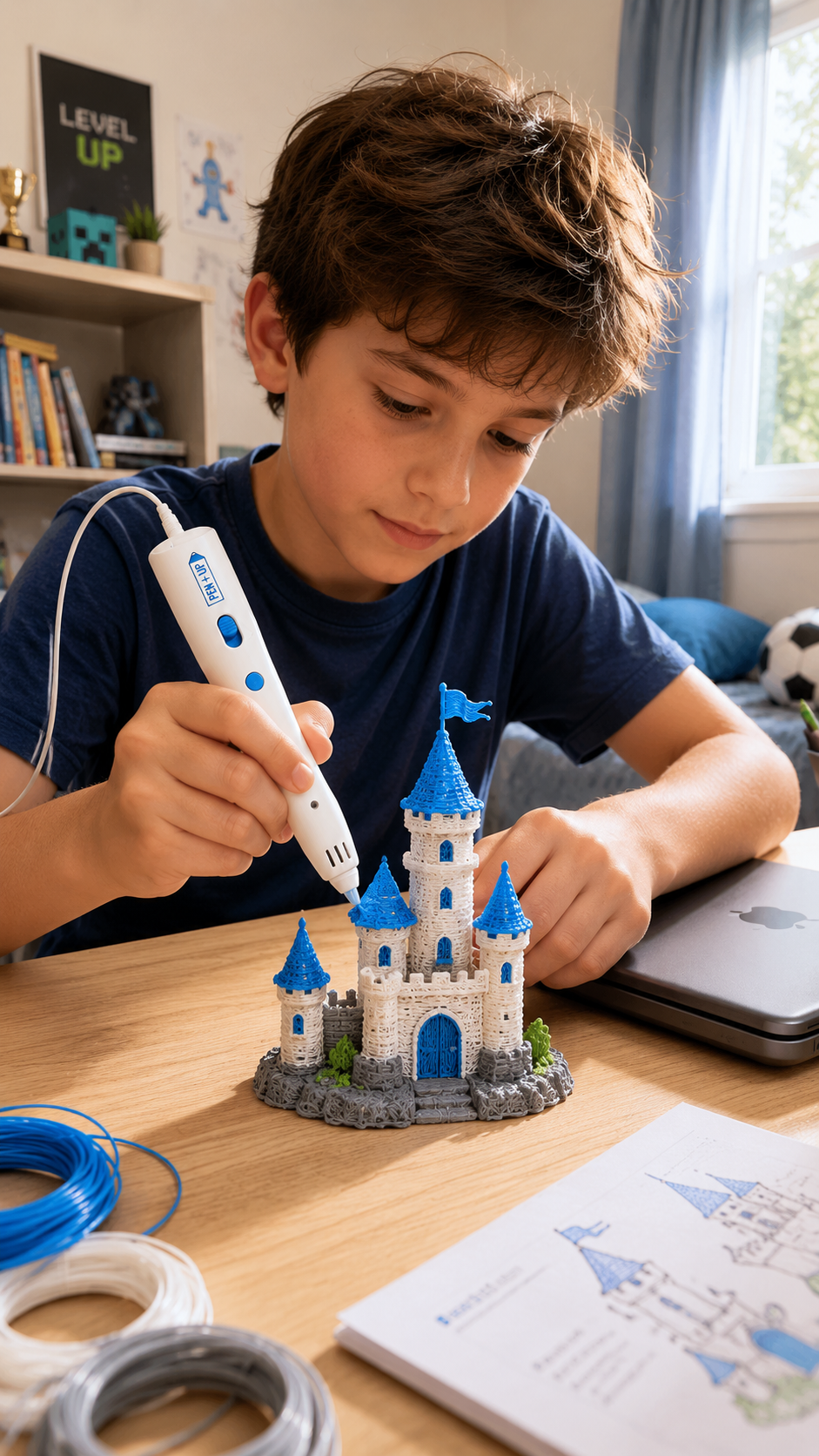
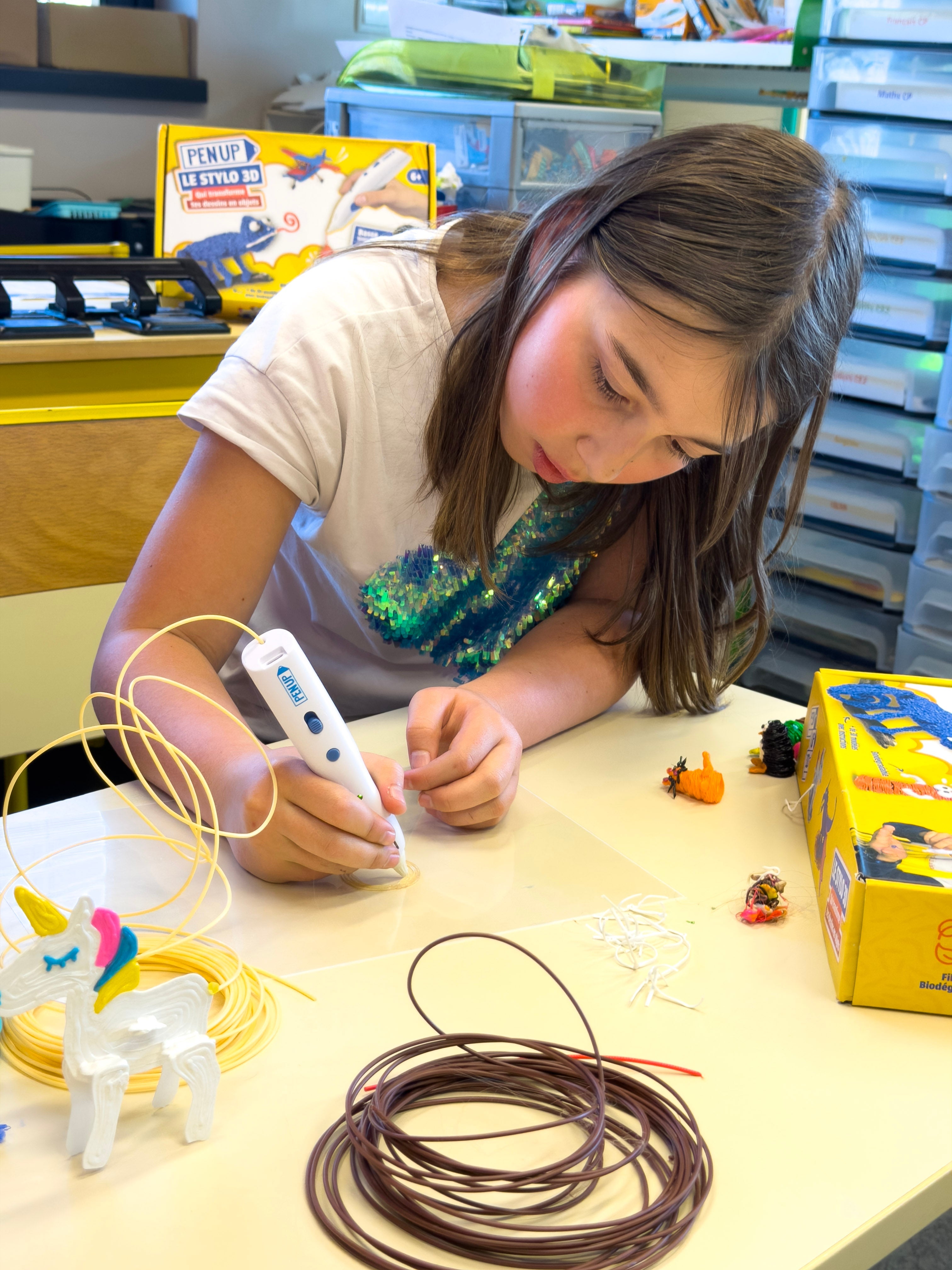
The 3D pen exercises fine motor skills and hand-eye coordination from age 6: holding the pen, controlling button pressure, guiding the filament along a line. Around age 8, children gain the dexterity needed for smooth lines and 3D modeling. These precise movements support and prepare handwriting development, with a pen tailored for little hands.
This is no minor detail: research on large cohorts of children, published in Developmental Psychology (Grissmer et al., 2010, link), found that the level of fine motor skills at school entry is statistically associated with later achievement in reading and mathematics. This is an observed correlation, which does not mean that a specific manual activity will directly boost academic grades, but it confirms that these precise fine motor movements are part of a child's normal development.
The activity then becomes an ideal training ground: children refine their fine motor skills without even realizing it, because they are focused on their creation, not on the exercise. The 2 speed modes make it easy to start slowly, then speed up once their hand becomes steady.
Why does the 3D pen improve concentration?
The 3D pen requires following a project from start to finish: trace, wait for the filament to harden, assemble, adjust. With about 1 hour of battery life (and the option to create while charging via USB-C), a session easily covers the attention span of a child aged 6 or older, in a calm, screen-free setting.

This ability to stay focused on a concrete task is a skill that can be developed, and the 3D pen naturally engages it. Far from the distractions of screens, children learn to take their time and see through what they have started. Wireless during drawing, their movements are never interrupted, and the auto-sleep feature handles ending the session for them.
Mihaly Csikszentmihalyi's work on "flow"—that state of deep absorption in what you are doing—showed in students (Shernoff et al., 2003, School Psychology Quarterly, link) that concentration peaks when the challenge matches one's skill level, neither too easy nor too hard, and when the individual maintains control over their activity. Although this study focused on high school students rather than young children from age 6, it describes the exact logic of a progressive creative project, where the child chooses a slightly more ambitious template each time.
Does the 3D pen boost self-confidence?
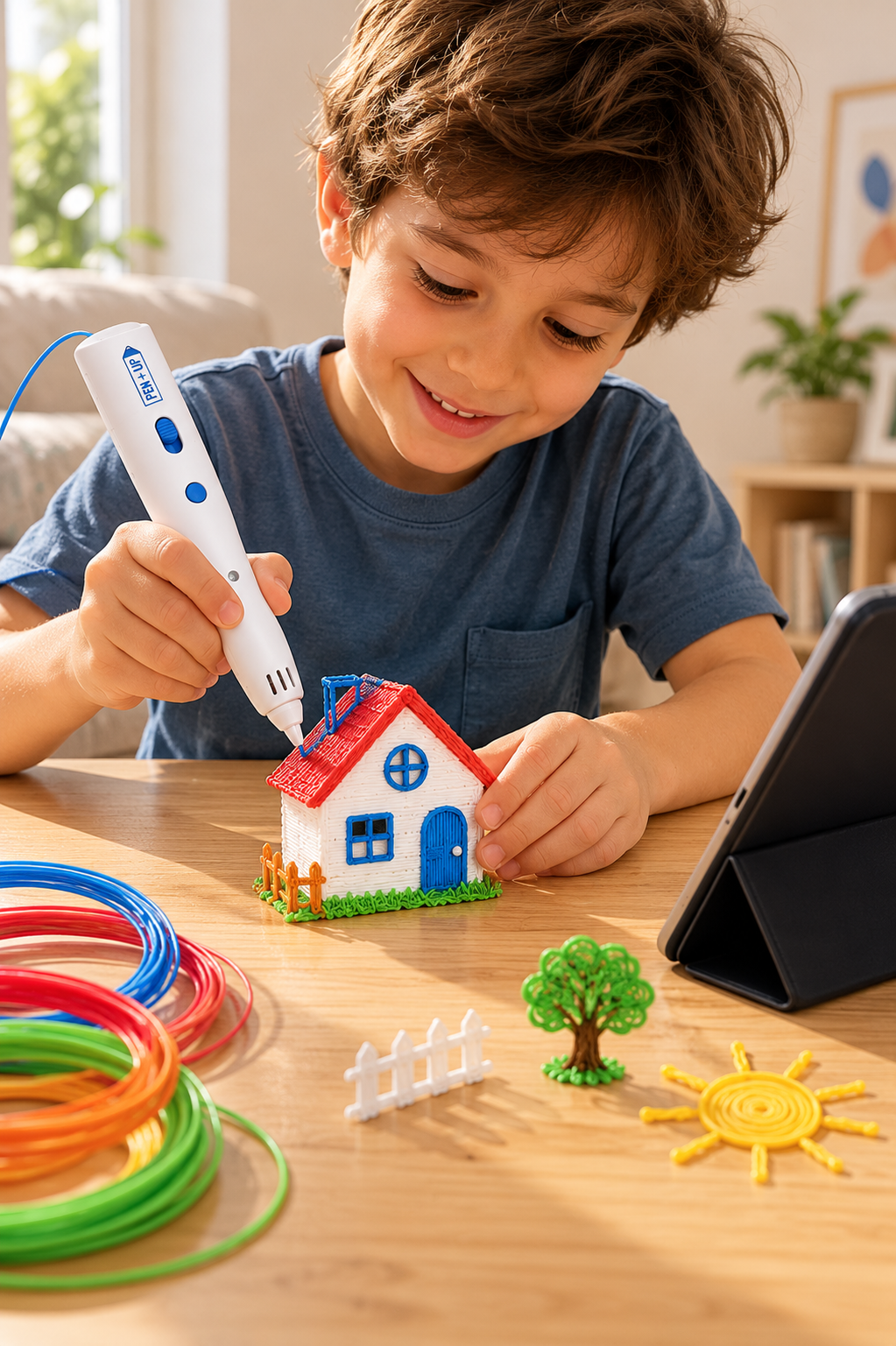
Yes, and it is one of the most frequent comments among the 2,300 verified reviews (4.88/5 on Judge.me): the pride of creating an object with their own hands. When children finish their first flower or their name in 3D, they did it themselves—they can show it off, gift it, or keep it. From the very first minutes, even a less confident child achieves a tangible result.
There is a huge difference between consuming content and making an object with your own hands. This sense of accomplishment nurtures self-confidence. A study by University College London involving over 6,000 British 11-year-olds (Mak and Fancourt, 2019, Annals of the New York Academy of Sciences, link) observed that those who regularly draw, paint, or make things report higher self-esteem on average, especially when creating with their parents. The researchers note that this is an association, not proof of cause and effect, and that regular practice matters more than raw talent.
And because the 3D pen requires no initial artistic talent, progress comes quickly: each successful build inspires them to try the next, slightly more ambitious one. Creating alongside your child, rather than just watching from the sidelines, is a great habit to adopt right from the very first sessions.
How does the 3D pen foster creativity?
The 3D pen transforms children from spectators into creators: an idea in their head turns into a real object in just a few minutes. To get started, they rely on templates to trace, stencils, and age-specific activity books (6+, 9+, 12+), before inventing their own shapes.

Instead of just following instructions, they imagine, test, and try again. It is one of the few creative hobbies that offers this immediate transition from imagination to reality. Children develop their spatial imagination: they learn to visualize an object from every angle, anticipate steps, and structure an idea.
Which benefit to focus on at each age?
From age 6, the benefits of the 3D pen evolve alongside the child: around 6–8 years, fine motor skills and precise movement; around 9–11 years, concentration and 3D volume projects; from age 12+, open-ended creativity and complex builds. The age-specific activity books (6+, 9+, 12+) follow this exact progression.
| Age | Key benefit | What the child does | Recommended material |
|---|---|---|---|
| 6–8 years old | Fine motor skills, hand-eye coordination | Flat tracing, stencils, first simple shapes | 6+ booklet, stencils |
| 9–11 years old | Concentration, patience, methodology | 3D objects, assemblies, multi-step projects | 9+ booklet, templates to replicate |
| 12 years and + | Open-ended creativity, self-confidence | Personal creations, complex structures, handmade gifts | 12+ booklet, open-ended creations |
What about children with special needs?
Thanks to its concrete, repetitive, and soothing nature, the 3D pen is one of those hands-on activities that many families love: it keeps hands busy, delivers a tangible result, and boosts the child's confidence. The 35 °C tip (temperature verified by a third-party lab, with no risk of burns) allows for safe and worry-free handling, with no hot parts to watch out for.

Let's be clear: the 3D pen is a creative hobby, not a therapeutic device, and it in no way replaces tailored professional support. It is simply an activity that many families find positive, to be explored on a case-by-case basis depending on what the child enjoys.
What are the conditions to enjoy these benefits with total peace of mind?
A 3D pen for children must be low-temperature: the tip of the Pen'Up 3D stays at 35 °C on the surface (verified by a third-party laboratory), with no risk of burns, whereas high-temperature PLA/ABS pens reach 190 to 240 °C and are meant for teens and adults. It is CE compliant, EN71 tested, and designed for children aged 6 and up.
- Safety: the tip stays cool with no hot parts; PCL filament melts inside the pen at around 60 °C.
- From age 6: quick to master, perfectly sized for small hands, and comfortable to use from age 6.
- Low-temperature filament: Fil'Up PCL refills, 10 m spools (Ø 1.75 mm), from €4.99; use only official Fil'Up spools, as unsuitable filament may clog or damage the pen.
- French brand: designed in France, customer support in Montauban with replies within 24 hours, lifetime warranty (free replacement).
To provide a complete, ready-to-use kit, the Pen'Up 3D Complete Pack (€99.99) includes the low-temperature pen, stencils, templates to replicate, and several spools of colors—everything needed to start creating from day one. And to understand everything before making your choice, our complete guide to 3D pens for kids answers all your questions.
FAQ: 3D pens and child development
What are the benefits of a 3D pen for a child?
The 3D pen develops fine motor skills, concentration, self-confidence, and creativity. Children turn ideas into tangible objects, nurturing their sense of accomplishment during quiet, screen-free moments.
Does the 3D pen help develop fine motor skills?
Yes. Holding the pen, controlling pressure, and guiding the filament engage hand-eye coordination and fine motor precision—skills that are particularly useful, especially around age 8, to support handwriting development.
At what age can children start enjoying these benefits?
From age 6, with no upper limit. Under 6 years old, adult supervision is recommended.
Is the 3D pen suitable for children with special needs?
With its tangible and calming nature, the 3D pen is one of those hands-on activities that many families enjoy. It is a creative hobby, not a therapeutic device: it does not replace any tailored professional support and should be discovered on a case-by-case basis.
Is the 3D pen a good screen-free activity?
Yes. It is a 100% hands-on activity that develops creativity and concentration while keeping children away from screens, making it a favorite alternative for parents.